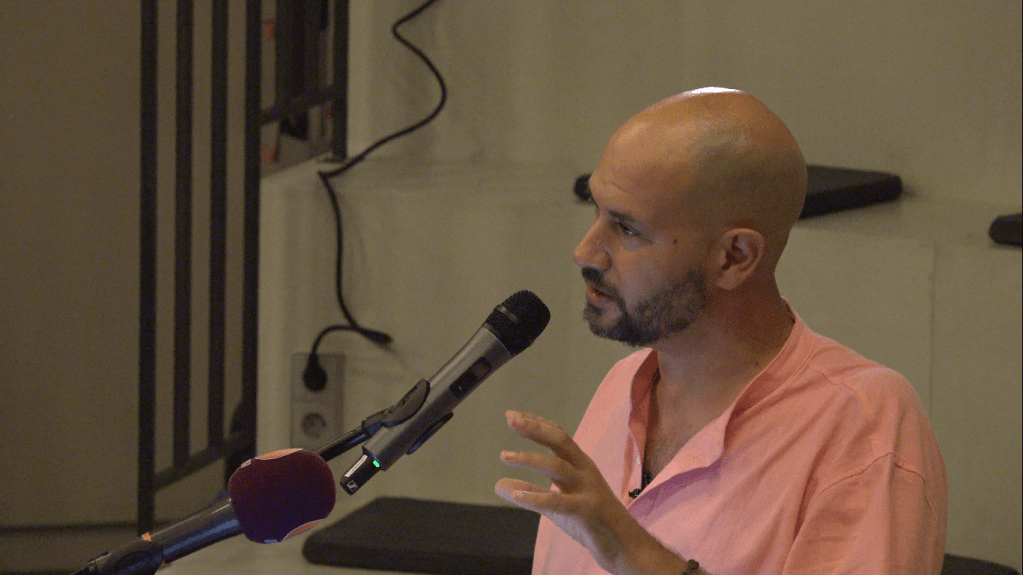
You can find the full speech tanscribed below:
Welcome to this amazing event that I am very happy and very honored to be able to introduce. I’m going to try to do a little bit more than an opening speech as those speeches are usually just celebratory affairs: where we say “welcome and isn’t this all great and fun?”. I’m going to try to squeeze some substance in. So please bare with me, even though I have only 20 minutes.
Now, when I received the invitation to speak here today, I was tremendously flattered. And I shared this with a fellow that I share my office with in Coimbra University, Portugal. And you know, I gave him the brochure of the academy to read, he’s a really nice guy, and but he’s a professional economist, so there are certain limitations in communication. And he said: “Listen, this is very poetic, but this does not look realistic.” I thought this is the greatest compliment he could actually give us, because it should not look realistic, because we do not aspire here to affirm reality. We aspire to oppose it. Reality is indeed very real in that it really oppresses us. But reality is not fate. And underneath and against the terror of the modern capitalist reality, there’s a displaced, oppositional and democratic knowledge, anachronistic and antagonistic temporality that could never be synchronized with institutional reality of capitalist modernity, and with its foundational life, foundational deception, the deepest dogma of burgeouis society, which is that ordinary people are somehow incapable of solving their own problems by themselves and for themselves, which is why the management of common problems belong to competent people.
So I would insist that both the authoritarian conception of politics (left, right and center) and the disciplinarian organization of Social Sciences had their origins in the bourgeouis mode of thought. Now: structures of knowledge that today are called Social Sciences are very recent, and many people do not know that. Between 1750s and 1850s the number of names used to describe the social sciences were approximately 200. The economist William Stanley Jevons, not a very nice man, complained in 1879 that we have too many names for economic research. We have, he said, political economy, we have plutology, we have chrematistics, we have catallactics. So unfortunately, the least imaginative term – economics – has prevailed, and we are sort of stuck with it. But important thing to say about these disciplines, it’s not just that they are recent. They are very recent, but they also emerged against the background of at least two complicated historical contexts. The first one is a several century long transformation of knowledge and knowledge systems that led C.P. Snow in his famous Cambridge lectures to coin the term “Two Cultures”.
Namely, before the 19th century, there was only one knowledge culture, the search for the True, the Good and the Beautiful. In medieval Europe, at least, the Church was a dominant epistemological authority. In a sense, all of the knowledge was theological. Gradually, however, between the 15th and the 18th century, the philosophers were able to push theologians aside. The work of philosophers, however, seemed to abstract, with too little immediate practical consequence, so around 1750s, natural scientists began to assert very persuasively that the search for truth had to be located in the concrete world of empirical observations. Now this process ended with the separation between two cultures. On the one hand, you had science imagined as a quest for truth through research and philosophy imagined as a search for moral laws through speculation. This separation is extremely important, because what it did was creating a separation between a quest of the truth to research and the quest for moral society. There’s a clear division here that’s implied between what is true and what is just, between scientific truth and the true society.
The Italian anthropologist by the name of Cesare Lombroso, who was famous for inventing of hereditary criminality, mostly among Roma people and the anarchists, said that for the dreams of the theologians and the phantasms of the metaphysicians we have substituted a few dry facts, but they were facts.
The second complicated historical context is the aftermath of the French Revolution. Now the French Revolution left us with two cultural concepts. One is the reality of change: Social change is something normal and acceptable. The second one is the sovereignty of people affected through the modern nation state. This is the conceptual basis and the foundation of capitalist modernity. Now the combination of these two cultural concepts, change and sovereignty of the unified people, which the people are unified with the nation, led to the dominance of centrist liberalism that lasted until the world revolution of 1968, shaping and informing very important and very big parts of both right and the left.
Another way to say this is that centrist liberalism, now a defining ideology of capitalist modernity, has imposed itself in four crucial spheres. The first was the creation of the modern nation state. The second was the exclusive concept of citizenship, excluding women, the working classes and ethnic, racial others. The third was the private property regime. And the fourth, interesting for us, is the emergence of the social sciences as the organized research of the social world, distinguished from humanities on the one hand and natural science on the other.
Now, social sciences were absolutely crucial for the liberal capitalist structure. In the beginning, they were nothing more than social movement coming from below. They were sort of a guide for social policy, for social reconstruction, for organization of knowledge. And they were spread through institutions that were not universities. The earliest were associations called the Statistical Association of Manchester, the Social Science Association, American Social Science Association, and all of the early positivist social scientists insisted that knowledge produced by Social Sciences has to be useful, practical, and in that sense, profoundly political.
Antony Giddens, not my favorite sociologist, but an interesting guy, made an important and revealing point when he said that the early sociology of Emile Durkheim, who is the founder of sociology, was rooted in an attempt to defend the claims of political liberalism in the face of twin challenge from conservativism on one hand and from socialism on the other. In the United States, when Albion Small sought to convince the authorities to allow him to found the American Journal of Sociology, he wrote to them that a journal was needed to restrain the utopians and to encourage well advised attempts at social cooperation. So we are coming to the definitional issue of liberalism here. The key element in liberal organization of knowledge is the management of common affairs by competent people. Let’s call this elitism. The other key element was evolutionism. The concept of evolutionism, stadialism, history moving in stages, was put forth in France and Scotland in the mid 18th century by Turgot and Adam Smith, and this is what John Locke actually meant when he said that “in the beginning, all the world was America”. The third one is economism, which is an assumption that what essentially drives human beings, all of us, is really our desire to maximize the utility, to get as much as we can from our pleasures, from our material possessions, and that all the significant human interactions have to be analyzed in market terms.
So social sciences, coming from below, inflected by the ideas of evolutionism, elitism and economism continued to develop slowly in the late 18th century, with remarkable success. But despite that success, some of the reformers sought to break away from the Social Science associations and create new professional academic structures, what is sometimes called – terrible expression – the community of the competent. The professorians, the community of the competent, moved to the University, and that was the modern university, the new university, which assumed a central role, not only in reproduction of knowledge (medieval university), but also production of knowledge, which is the modern university. That means that an entirely different structure was created. Scholars earned their salary within the universities, they worked full time there. They were placed in the departments, organized around disciplines, which were defined very simply: vocabulary, plus organization, plus journal, plus conference. And these structures were created relatively quickly, Oxford adopted new statutes in 1800 and 1817. But more importantly, the rise of the recent university was intimately linked to the rise of the modern nation state, new professional historians were sent to the archives so as to discover the memory of the modern states. As Eric Hobsbawm memorably says: historians were to nationalism as poppy growers were to heroin addicts. We, the historians, supply the essential raw material for the market.
He was not wrong. After the Paris Commune in 1871 history became absolutely central to integrating the State. Again Hobsbawm argues that historians invented imagery, symbolism and traditions of the Republic to control the working classes. One of the main concerns of positivist social science was precisely to establish a society based on the model of the Republic and not of the Commune. The Commune in 1871 liberated itself from the jacobin myth of the community of the competent, reminding the world that the secret of every revolution resides in the creative activity of the masses. Now that was the real threat, the threat of communal politics, the threat of communal property, the threat of communal knowledge, the threat of communal luxury that social sciences were really invented and constructed to manage and dispel.
Historians were sent to the archives to secure the past, but in order to secure the present, the State had to create sociologists, economists and political scientists, anthropologists and orientalists were invented in order to study non western people who have not yet made the “evolutionary leap to modernity”. Eventually, social sciences have been organized around three axes, past and present, West and non-West, and around the liberal organizational society where political science studied the state, economics studied the market and civil society was studied by sociologists, the “Liberal Trinity”. So as we enter the 20th century, the three parts of organization of university, between humanities, natural sciences and social sciences was very stable, but was not completely immune to challenges. The first challenge came from the Area studies, the new way of organizing knowledge dictated by the Cold War geopolitics, more than anything else, at some point, everybody had to be an expert in inner Asia, where Soviet Union was waging war in Afghanistan. But Oriental Studies in anthropology, because of all of this, started to loose intellectual legitimacy. More important challenges came from below, and this is the revolution of 1968 which pushed the disciplines to fiercely self reflective and critical direction, which again undermined the stability of the idea of the disciplines. And the most serious challenge, unfortunately, came from above during the 1980s during the right wing coup, as we call neoliberalism, when they started to push for defunding, bureaucratization and restructuring of Humanities and Social Sciences. This includes the university system, of course, as the main locus of knowledge production. In the period after the Second World War, we had a great expansion of the university system. But in the recent years, the very existence of the university has been brought into question, not only United States, from where you hear the horror stories, but also in Europe as well and everywhere else.
So we find ourselves today, those of us who are working in universities at least, in structures of knowledge that are confused, not useful, searching how to survive organizationally in a moment of transition: Fourth World War, both systemic, multi ecological crisis. Social sciences are really constructed visions of the changing world, and it’s completely inevitable for them to be reconstructed. But the question is, who is going to do this? Is it going to be a social movement from below, or is going to be a social movement from above? The first step if we are to reinvent Social Sciences, which I believe we have to, and this academy is one of the many and probably one of the first places that is actually taking up that challenge is to recognize the intellectual irrelevance of the disciplinary boundaries created between 1880 and 1945.
The answer to the crisis is most certainly not that dreaded idea of interdisciplinarity that only affirms the reality of capitalist modern knowledge structures. The only viable alternative project is undisciplining social sciences and the idea of a singular social science, this is what Abdullah Öcalan recently called sociology of freedom. His proposal builds on the experience of at least four schools that I don’t have time to go into, but I will mention: Standard Wiesenschaften, State Sciences that come from Germany, the School of the Annales, the movement, really, of the Annales in France, around the Journal, the English Journal of Past and Present, that push for a Marxist understanding of society and history. And finally, Fernand Braudel Center in Binghamton, as the American part of this international constellation of resistance. All four schools insisted on analysis of economies of a long historical time and large space, holism of the social historical process and transitory nature of theories. This is in deliberate opposition to the universalizing British dominated social science, which really was an attempt to redefine the existing situation of the world into eternal truths. “What exists is what it is and it has to be”. Now I don’t have the time to go into the story of Annales and Francois Simeon and his historical method and Social Sciences, which was really a manifesto published in 1903 that was the first plea for a unitary social science that’s not interdisciplinary.
Bloch, Favre, Fernand Braudel created a new kind of science of history, the science of the past, the science of the present, which stands in dialectical opposition through the idea of Leopold von Ranke, that history’s discovery of what really happened. Braudel, in 1970 created the term “unitary inter science”. Inter science, for Braudel, was everything, not interdisciplinarity, not collaboration with anthropology, sociology, ethnology, what have you. It was one science, one historical social science. And it was the same thing for Emmanuel Wallerstein in 1976 when he created, together with Terence Hopkins, the Fernand Braudel Center with the same idea, with the experience of the Annales as something that was extremely successful, but something that was eventually co-opted. Emmanuel Wallerstein was very much aware of this, but he insisted passionately for the idea of unidisciplinarity, for the idea of historical social science. I was in Binghamton. Many of the people here were in Binghamton, and we never thought of ourselves as sociologists. We were historical social scientists, and we really tried to refuse the cooptation by the disciplines. Eventually, we did not succeed.
More or less world systems has been kind of shut into the discipline of sociology. I now edit a Journal of World Systems Research, which is published within American Sociological Association. Wallerstein sort of predicted that, Emmanuel used to say: “the greatest danger that can happen to you is if you are successful, if you are successful, you’re either going to be crushed by the capitalist modernity, or you’re going to be co-opted into one of the disciplines. So this is something that is very relevant now as experience, because we enter today the new cycle of this epistemic political struggle. And several years ago, Abdullah Öcalan, from his prison cell, issued a call for a new kind of social science. His words bear striking resemblance to Braudel’s and Wallerstein’s: “overcoming the crisis in the social sciences”, he says, “is a priority. Social sciences”, he argues, “are Eurocentric concepts, damaged concepts, political concepts. How”, Öcalan asks, “can we separate the idea of scientific truth from that of a true society?” He continues in the beautiful passage: “a social science that makes social nature as a whole, in all places and at all times, the topic of research, has two tasks. On the one hand, it must provide the direction for physics, chemistry, biology, cosmology, all of which are connected to society. And on the other hand, it must orient the humanities, including philosophy, literature and the arts. It will bring together the end of separation between truth and freedom. The family tree of science can only be drawn with the social sciences and its roots. The fundamental unit of analysis of such unified social science is moral-political society, which I consider”, he says, “to be the very state of existence of social nature. The ultimate goal of social science is to develop the option of freedom.”
Now sociology of freedom would be a singular social science, once again, one that defines freedom as awareness of life and truth as exploration of freedom. There’s so much agreement here between Wallerstein and world systems analysis, between inter science and Braudelian analysis. There’s so much here that brings all of these ideas together. For Öcalan, just like for Braudel and Wallerstein, separation of two cultures has led the search for good society to be effectively eliminated from the world of knowledge, and the search for the truth circumscribed into the world of microscopic positivism. So to overcome the crisis of social science is to recognize that knowledge is a singular enterprise, and there are no fundamental contradictions of how we may know the natural and social world. They’re both integral parts of the same universe, and truth cannot be separated from fantasy, from art, from beauty, from justice and other such things which positivists show neurotically regret.
In this way, social science could be a crucial link connecting Natural Science and Humanities.
Now in what do we do from here? How do we think about this movement from below?
As I don’t have enough time, and I want to allow time for the program to continue and unfold, I’m just going to ask: How can we think? And this is something that we need to think collectively, all of us. How can we avoid a mistake of being crushed or altered this time around with this new attempt to create a new kind of social science. The proposal, or at least part of the proposal behind the Academy of Social Science, is that we should refuse to perpetuate the liberal organization of knowledge and state centered science, our task is to institute intellectual structures of knowledge, that are going to be useful in the struggle for a new democratic civilization. If the old social sciences were social movements for liberal reform, new social science should become a social movement for democratic civilization. Liberalism imposed on to us, organization of knowledge around market, state, society. Revolution in Rojava, the kurdish democratic tradition has brought to us a very different kind of trinity. It’s behind me, women, life, freedom. So we should organize new social science around the study of these three categories, defined as broadly as possible, as an integral knowledge of women, freedom and nature.
In terms of organization, we could work on establishing a world confederation of institutions of knowledge making, a democratic confederation of research centers, academic programs, social movement universities, indigenous universities, community schools and academies, academic journals coming together to develop a new vision of scientia, a vision that promotes the option of freedom as an awareness of life and then pursues the truth as exploration of freedom.
This kind of integral knowledge is desperately needed today, when a kind of universal fascism permeates both the thinking and practice of the ruling classes. But we are not going to be able to create such knowledge if we are realistic, if we don’t refuse the reality.
And to refuse reality means to confront the crisis that runs much deeper than what we call politics or economy or society, since even the language that we use has to be recovered and learned anew, so that we, as that Lebanese poet put it so beautifully, “can finally write the words that speak”.
This, writing the words that speak, and sharing them with ordinary people, completely able to comprehend them, understand them and make them their own is the idea of the Academy of Social Science.
Thank you and welcome