By Patrick Huff and the Editorial Collective
Dear readers,
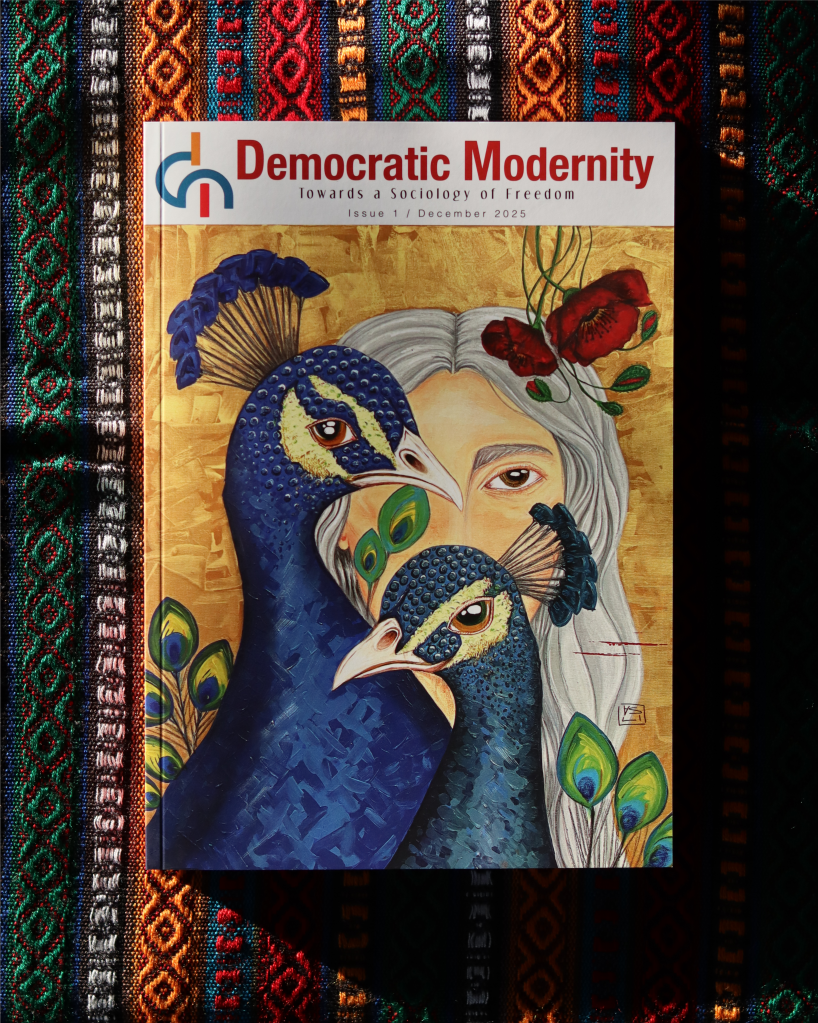
We are pleased to welcome you to the inaugural issue of our journal, Democratic Modernity. This is the publication of the Academy of Social Science, an international collective of scholars, activists, artists, and people in struggle. Our perspective is rooted in the Kurdish Freedom Movement (KFM) and the insights of Abdullah Öcalan, the movement’s leading strategist and thinker. Though we have an editorial perspective we are not burdened by any doctrinaire line. We mean this journal to be a space of critical inquiry, intellectual encounter, and dialogue. For this purpose, we do not draw a hardline between traditional scholarship and knowledge(s) produced by and for movements and communities in struggle. We see no contradiction between intellectual thoroughness, precision, and diligence, on the one hand, and creativity, playfulness, and imagination, on the other. To borrow a turn of phrase from Ursula K. Le Guin, if we are realists then we are “…realists of a larger reality.” We view our efforts to explore this larger reality as part and parcel with Öcalan’s (2020) proposal to develop a sociology of freedom.
In the following sections we’ll discuss the journal’s aims and purpose. We’ll first briefly contextualize our efforts here through a brief sketch of some of the major turns in the history of the KFM. With that historical context in mind, we will then discuss our rationale for launching this new venture and we’ll explore the conceptual and methodological concerns which inform our editorial perspective. Finally, we point out some of the themes we hope to see explored and developed in subsequent issues of the journal and provide practical pointers for those interested in contributing to the publication.
Our Roots
We might say that, depending on how we want to account for our origins, this journal was born in the heady days of student and worker struggle in Turkey after 1968, when Öcalan first whispered to his friends that Kurdistan was a colony, and so its liberation was necessary for Turkish liberation and part of a global struggle against empire. Or we might say it raised its head for the first time in the mountains of Kurdistan, as the struggle for Kurdish existence took practical form. We could also just as well claim that this journal was born in an isolated prison cell on İmralı island, as, under the watchful eye of the Turkish state, the KFM’s “new paradigm” was forged and proposed to the world in 2005. Or still we might say that this journal was born out of countless discussions among activists networked across cultures, borders, countries, and continents, as they tried to comprehend the remarkable, revolutionary experiences taking place in West Kurdistan (Rojava) and North-East Syria since 2012. All these origins are true because this journal is rooted in a long history of the struggle for Kurdish existence.
Through colonial processes of partition and nation-state formation imposed in the first decades of the last century on populations across the Middle East, Kurds and many other peoples suddenly found themselves to be minorities in the new states of Iraq, Iran, Syria, and Turkey. Kurds and other minorities, to varying degrees, were seen as a problem for the homogenizing designs of ethno-nationalist majority governments. Kurds have been subjected to policies of cultural erasure through forced assimilation and, in the darkest times, outright physical annihilation. The struggle has been existential from the beginning.
Even though armed militancy was at times a crucial means of survival, the Kurdish Freedom Movement (KFM) has generally emphasized political solutions rather than military victories. Over the decades the movement has shown tremendous capacity for adaptability, critical reevaluation of its means and ends, and internal self-transformation. For instance, in the midst of rapidly increasing participation by young women in the late ’80s and early ’90s, the KFM initiated a critical discussion on the role of women within the movement and in broader Kurdish society, and as a result, women’s liberation became centered as a pillar of struggle.
This process of critical reevaluation was underway in 1999 when Abdullah Öcalan was abducted by a coordinated international effort on behalf of the Turkish state and renditioned to Turkey’s notorious Imrali island prison where he has spent the last 26 years in torturous isolation. Öcalan, nevertheless, continued his search for solutions. He managed, though severely restricted by his jailers, to access books and other materials as part of preparation for his legal defense. Alongside works of critical theory (Adorno 2006) and world-systems analysis (Wallerstein 1974; Frank and Gills 1993), Öcalan encountered Murray Bookchin’s (2005) writings on social ecology and libertarian communalism, which proved to be pivotal to his thinking.
Öcalan’s multivolume Manifesto of the Democratic Civilization can be read as an act of grand intellectual synthesis and the beginning of an open dialogue with individuals and movements across the world who struggle for freedom. With Öcalan’s proposal for democratic confederalism, democratic autonomy and democratic nation, the Kurdish Freedom Movement abandoned its desire for a nation-state and, instead, embraced “a non-state social paradigm” emphasizing women’s liberation, direct communal democracy, and ecological sensitivity. These are the principles that have animated the revolutionary struggle in Rojava, North and East Syria, which brings us back to the rationale for this journal.
The Need for a New Journal
Why this journal? Why now? We believe that the theory and practice of the Kurdish Freedom Movement has already made significant contributions to a diverse global dialogue in struggle against the deprivations and predations of capitalist modernity. And we believe it can contribute even more. We believe that the animating social philosophy behind the successes of the KFM calls for serious and sustained intellectual engagement. In the spirit of revolutionary Rojava, we view this journal not only as an intervention into contemporary critical discourse but, more ambitiously, as a contribution to a radical reconceptualization of social science as a vehicle of human emancipation — the sociology of freedom.
It hardly needs stating, of course, that we live in an era of growing, potentially terminal, crises. War, ecological breakdown, resurgent fascism, and genocide are the interrelated co-morbidities of a system incapable of resolving its own antagonistic tendencies. Against this, we envision our journal, Democratic Modernity, as a platform for exploring pathways out of this trap. Our critique emerges from hope. Ours is not a passive or wishful hope but rather a hope in the power of imagination and grounded in the real possibilities immanent in our world. This, of course, calls for a different mode of critical theory. “To think hope is to enter into a different grammar of thought,” as one of us wrote elsewhere (Holloway 2022, 27).
This is one reason why we find Abdullah Öcalan’s work so timely. From his isolated prison cell, guarded by the full force of the Turkish state, under conditions that would seem completely hopeless, Öcalan has nevertheless managed to go a long way towards contributing to a different grammar of hope. Not the least of which is his proposal for a sociology of freedom which we hope to develop further through this journal as a conduit for dialogue across intellectual and political boundaries.
Methodological Framework: Toward A Reenchanted Social Science
Öcalan’s project can be characterized as a revaluation and imaginative reconstruction of dominant conceptual schemes, myths, rooted in patterns of thought that first arose in the ancient civilizations of Western Asia. His vision is that of la longue durée. His interpretation of the long-term civilizational trajectory involves both deep historical continuity and change. It’s not so much that ancient power structures are wholly replaced by new ones but rather the old is reincorporated in the new. It is important to note here, though, that he is not attempting to do the work of a conventional historian. In Öcalan’s estimation the problem with much of modern scientific discourse isn’t that mythology is missing but rather that it itself disavows its own mythological underpinnings (2015, 33). Öcalan’s methodology can be characterized as a form of reconstructive mythology. This should not be confused with a rejection of factual discourse but rather a recognition that factual discourse, and the facts to which we attend, are contested and fundamentally oriented by meaning and values.
Myths are, to paraphrase Midgley, an inextricable part of science, the part that decides its significance in social life (2011, 1). Under this account the self-declared disenchantment of capitalist modernity was rather simply a disavowal. We have never been disenchanted but clearly some enchantments are surely preferable to others. Enchantment’s disavowal that came with the raise of capitalist modernity generated a concomitant ruthless political nihilism and an instrumentalized (social) science disconnected from meaning and values. To embrace enchantment, on the other hand, is to accept the significance of meaning in all social endeavors including that of social science, bridging chasm of facts and values. This should not be seen so much as an achievement to be had but rather as a recognition of and conceptual reconciliation with that which already is inextricably in social practice. To speak of myth in this context is not to suggest a retrogression into a supposed pre-scientific archaic, quite the opposite. Rather accepting the myth in science allows for a supersession beyond current impasses.
As David Graeber, our late comrade and friend, observed,
[w]hat Öcalan is doing here is taking the same pieces and putting them together in quite a different way. In doing so, he is taking the lead from the unique situation of his native Kurdistan… (2015, 16).
In our own exploration of these “puzzle pieces” we aim to extend this open and imaginative approach in the pages of this journal.
We took the name of our journal, Democratic Modernity, in part to emphasize the aspirational, hopeful, and solution-oriented perspective we want to develop in these pages. The concept of democratic modernity names the coming to fruition of many interlocking emancipations from the dominant system of capitalist modernity. By way of comparison, one might think of the Zapatista desire for a “world where many worlds fit” or similar decolonial conceptions articulated in terms of pluriversal transmodernity (Dussel 2002; Grosfoguel 2006). As currently materialized in Rojava, Öcalan’s proposals for democratic confederalism, democratic autonomy, democratic nation, and jineolojî can be characterized as practical political methodologies for realizing the overarching desire for democratic modernity. Democratic confederalism, and its constituent democratic autonomous components, names “a non-state social paradigm” emphasizing women’s liberation, direct communal democracy, and ecological sensitivity. Similarly, “democratic nation” denotes a pluricultural geography of political affinity, reminiscent of Castoriadis’ (1997) notion of autonomy. Jineolojî is a programme of women’s liberation developed within the Kurdish women’s movement. All of these inform our thinking around the proposal for a sociology of freedom.
Our methodological approach is oriented toward exploration, interpretation and explanation, rather than the positivist desire for predictive power. Predictive social science is necessarily reductive social science. The aims of exploration and explanation are more appropriate for the complex and open systems which make up social life (Danermark et al 2019). Relatedly we see great value in the interpretive approach which, to appropriate Clifford Geertz’s apt observation, can be characterized not so much as a “…science in search of laws but an interpretive one in search of meaning” (2006, 5). An exploratory, interpretive, and explanatory framework thus informs our approach to the sociology of freedom which we see taking two distinct but related programmatic forms.
On the one hand, the sociology of freedom would investigate contemporary and historical forms that social freedom takes. A stunning example of such an approach can be found in David Graeber and David Wengrow’s (2021) The Dawn of Everything (DOE). Summarizing some of their key insights Wengrow (2024) recently wrote,
[I]n addition to proposing three elementary forms of domination (control of violence, control of knowledge, and personal charisma), DOE also posits three elementary forms of human freedom: to move away, to disobey, and to dismantle and redesign the social worlds we inhabit (9).
The sociology of freedom would also explore contemporary examples of social freedom emerging from emancipatory social movements like the project of democratic confederalism in Rojava or the “Juntas del Buen Gobierno” of the Zapatistas (Fitzwater, 2019), for instance.
On the other hand, a sociology for freedom understands and reframes social science itself as a vehicle for human emancipation. The critical role here is to identify, say, authoritarian beliefs and the institutions that generate and uphold them and through critical social analysis not only reject actions informed by those beliefs but also posit a potentially better or more adequate configuration of social relations to facilitate human flourishing in nature and indicate how we might transition to it (Bhaskar 2016). The sociology for freedom accepts that social science is not limited to merely describing reality but can legitimately evaluate, critique, and may entail acting based on its findings.
Taking these two dimensions into account, we might say in a sense that the sociology of freedom can be conceived as a reenchanted social science. In a significant sense this is precisely what Öcalan has tried to model. One need not follow Öcalan’s precise methodology to advance the programme. Part of our task in this journal is to facilitate an ongoing dialogue across diverse theoretical and methodological approaches to developing a robust sociology of/for freedom.
Conclusion
In this issue we have an outstanding line- up of articles and essays with contributions from John Holloway, Nik Matheou, Nazan Üstündağ, Raúl Zibechi, Benedetta Argentieri, Andrej Grubačić, Abdullah Öcalan, Laura Fantone, Harriet Friedmann, Havin Guneser, and Reimar Heider. From a variety of vantage points our authors setout and develop themes of truth, freedom, democracy, autonomy, artistic creativity, critique, epistemology and more. These themes and concerns resonate not only with the theory and practice of the Kurdish Freedom Movement but form potential points of contact between the KFM and other movements in struggle. This issue lays the groundwork for future issues. These offering express an abundance of hope which acts as something of the issue’s leitmotif.
We conceive this inaugural issue of our journal, Democratic Modernity, as an announcement, a provocation, and an invitation. We announce a future beyond capitalism, the state, and patriarchal domination. This future is, however, already taking shape in myriad of diverse emancipatory social projects across the world. For instance, the social revolution in North and East Syria, Rojava, is among one of the most spectacular of these eruptions of the future-in-the-present. We realize that the future will not come in one single rapturous break with the past and present. Rather we see a better world percolating and proliferating at differing temporalities and across geographies. These struggles create interlocking emancipations in potentially ever widening and overlapping circles of collective freedom and autonomy that constitute the ascent of democratic modernity against-and-beyond the imperatives and terminal compulsions of capitalist modernity.
We want this journal to provoke a radical reimagining of social science as emancipato- ry science, as the sociology of freedom. The dictum equating knowledge and power has served as something of an epistemic rationale synonymous with the pursuit of (social) science. Whether in its early modern Baconian statement that “knowledge is power” or its postmodern Foucauldian critique under the rubric of “power-knowledge,” the equation presupposes and reduces (social) science to instrumentality, supremely efficacious to be sure but value-less, nonetheless. We begin from a different emancipatory epistemological rationale: truth is freedom, understood as a dialectical mutuality. Now, obviously, there is far too much to unpack here in this brief concluding section. For the moment suffice it to say that, with the collapse of the Positivist science’s fact/value dichotomy (Putnam 2002; Norrie 2009), our conception of truth encompasses both efficacious knowledge and values necessary for an emancipatory social science. As Öcalan says,
[s]ocial sciences that interpret awareness of life as freedom and truth as the exploration of freedom provide indispensable guidance for moral and political society’s enlightenment and development (Öcalan 2020, 365).
With Öcalan we see a dialectical mutuality in the relation of truth and freedom, and we see science as a social process and collaborative project. This brings us to our invitation. We see this journal as an invitation to all who struggle in-and-against the current system of capitalist modernity and all its oppressions and exploitations. We invite you to contribute to this project of the radical imagination by joining us in dialogue in the pages of this journal. We are interested in research articles, essays, and book reviews that develop the primary themes and concerns outlined in the editorial discussion above. For further information about publishing with us check out our website here.
References
Adorno, Theodor. 2006. Minima Moralia: reflections on a damaged life. London: Verso Books.
Bhaskar, Roy. 2016. Enlightened Common Sense: The Philosophy of Critical Realism. London: Routledge.
Bookchin, Murray. 2005. The Ecology of Freedom: The emergence and dissolution of hierarchy. AK Press.
Castoriadis, Cornelius. 1997. The Imaginary Institution of Society. Polity Press.
Danermark, Berth., Mats Ekstrom, Jan Ch. Karlson. 2019. Explaining Society: Critical Realism in the Social Sciences, 2nd ed. London: Routledge.
Dussel, Enrique. 2002. “World-System and “Trans’-Modernity.” Nepantia: Views from South 3: 221–244.
Fitzwater, Dylan E. 2019. Autonomy Is in Our Hearts: Zapatista Autonomous Government through the Lens of the Tsotsil Language. PM Press.
Frank, Andre G., Barry K. Gills, (Eds.). 1993. The World System: Five Hundred Years or Five Thousand? Routledge.
Graeber, David. 2015. “Preface.” in Manifesto of the Democratic Civilization: The Age of Masked Gods and Disguised Kings, 11-20. Norway: New Compass Press.
Graeber, D., David Wengrow. 2021. The Dawn of Everything: A New History of Humanity. Farrar, Straus and Giroux.
Grosfoguel, Ramon. 2006. “World-Systems Analysis in the Context of Transmodernity, Border Thinking, and Global Coloniality.” Review (Fernand Braudel Center) 29: 167–187.
Geertz, Clifford. 1973. The Interpretation of Cultures. New York: Basic Books.
Holloway, John. 2022. Hope in Hopeless Times. London: Pluto Press.
Midgley, Mary. 2011. The Myths We Live By. London: Routledge Classics.
Norrie, Alan. 2009. Dialectic and Difference: Dialectical Critical Realism and the Grounds for Justice. Routledge.
Öcalan, Abdullah. 2020. The Sociology of Freedom: Manifesto of the Democratic Civilization, Vol III. PM Press.
Öcalan, Abdullah. 2015. Manifesto of the Democratic Civilization: The Age of Masked Gods and Disguised Kings. Norway: New Compass Press.
Putnam, Hillary. 2002. The Collapse of the Fact/Value Dichotomy and Other Essays. Harvard University Press.
Wallerstein, Immanuel. 1974. The Modern World-System. New York: Academic Press Inc.
Wengrow, David. 2024. “On historical materialism and ‘The Dawn of everything’.” Contemporary Political Theory, 23, no. 1 pre-proof copy: 1-14