By Nik Matheou
Hauntings of Capitalist Modernity
I start from the principle of hope.1 Hope is the very stuff of our ability to create meaningful bonds, relationships, lives and worlds. Why commit to do something together, to start some project, to make a life, to even strike up a conversation, if you’ve no hope that your bond will last in some way, will impact others in some way? Why struggle together, despite all our imperfections as individuals, and all the difficulties of collective organisation, if we’ve no hope that we can transform ourselves along with our lived conditions? We need hope, of some future in which our actions remain relevant, in which their effects continue to ripple, in which our lives continue to have had meaning, in which they will continue to be valorised in the rich texture of everyday life for those who come after. Without hope, we – all humans, everyone, wherever we are – are paralyzed, listless, unable to create, let alone to transform ourselves and the world around us.2
Of course we don’t arrive in this world as individuals, but as social beings; or, in John Holloway’s preferred rendering, social becomings. Our seemingly individual essences are continually made and remade by the social relations in which we’re always already situated, which produce us and which we produce in turn. So hope is essential then to all human sociality, and so every particular form of society that has existed over time and space. As the sum of all our relationships, with each other, with animals, and within and as part of the environment around us, we must be able to imagine ourselves in a society which gives socially recognised meaning, which gives value, to our actions over time and space, a society which holds the promise of becoming more than simply the sum of its parts, of transforming into a collectivity that truly realises the creative potentials in our sociality, human to human, human to animal, and all of us within and as part of our environments.
In the thousand years or so of human history commonly termed the Middle Ages, for example, universalising religious worldviews anchored in concrete institutions provided visions of societies much more than the sum of their parts: of the Christian people (populus Christianus) in Christendom, and of the community of believers (umma)in the Abode of Islam (Dar al-Islam). These terms denoted potentially universal communities not simply made up of associated people, but bound by a shared sense of morality, by political norms that embodied a sense of ethics, by an understanding of the “natural” order of humans, of animals, of things in the world, by a story of the past, a guide to the present, a vision for the future. The various human subgroups and communities within these collective imaginaries all found their place in a supposedly “natural” religious order, and those imaginaries pointed to a real communality created in the shape of congregations, monastic houses, Sufi lodges, and much else besides, which, in some times and places, even pointed towards true democracy in its vision of a world held in common beyond social antagonism. That Christendom and the Abode of Islam also distinguished non-believing, all-too-often demonised and persecuted internal and external Others, that they also functioned as the ideology of states and so of state civilization as a whole, and that they also manufactured “spontaneous” social consent to systems necessarily founded on exploitation, domination, and so on the accumulation of power, I leave to the side for now.
The same is true of the nationally framed states of capitalist modernity, emergent from the late Middle Ages, and generalised across the nineteenth and twentieth centuries. Hope was embodied in the nation, a community necessarily imagined, since no one can meet and meaningfully know everyone in the group they’re claimed by or claim to be part of, but no less practical for that fact.3 The nation-state presents itself as the realisation of a pre-existing group that has attained nationhood, acting as the proof of that nationhood, which constitutes the highest level of human aggregation before humanity as a whole. Much as the populus Christianus or Islamic umma, nationhood is founded on a story of the past, on the political legitimacy of a definite group with its own morality and ethics, its own “national values” in the present, and so a vision of this group’s future, which provides a kind of immortality for all its members dead, alive and yet to come.
For much of the nineteenth, and especially in the twentieth century, nationhood was the primary source of hope for people around the world, and across the political spectrum. The realisation of a better future, one in which our actions as individuals were valorised for the collective, in which they will contribute to the enriching of everyday life for those yet to come, was expressed in the formation and development of a nation-state. And, again, I leave aside for the moment the fact that the phrase ‘formation and development of a nation-state’ implies a project of social engineering, the conjuring of a “nation” out of inherently diverse and variegated populations, of endowing singularities of identification, language and culture with an almost divine reverence, of excluding defined Others as much as of including claimed members, of elevating to a level of unique political legitimacy one out of any number of potential social allegiances we might have. Simply put, the phrase implies an inherent logic of genocide; regardless of the extent to which this is realised in the process of a given nation-state’s ‘formation and development’, the logic is ever present.
At the same time as nationhood was elevated to the sole legitimate justification for statehood, the political entrepreneurs produced by capitalist modernity – the representatives of class, imperial and popular interests who sought to initiate struggles for hope – developed in turn three political and economic ideologies in which nation-states were given universal meaning. Like the multiple communities conceived within the religious “natural orders” of Christendom and the Abode of Islam, which gave them their practical expression and sense of universalism, the triune political and economic ideologies of capitalist modernity, liberalism, conservatism, and socialism, were preached by their respective entrepreneurs as universalising visions to nations-cum-states. For liberals, a nation realised as a state could become part of the story of the ‘Wealth of Nations’, freely trading and developing their industries, so that all might participate in Progress through humanity’s “natural” propensity to commerce. For conservatives nationhood referred to a moral-ethical entity embodied in traditional ruling classes and their time-honoured institutions, which must be preserved to avoid societal breakdown. For socialists, or at least those inclined to statist rather than libertarian strategies, the nation was, or at least should be, a horizontal collective in which all members are equal, able to generalise and so to abolish the subordinated state of popular classes and groups, with the state the expression of this collective’s political power. So, for these socialists, and many still today, state property was automatically understood as commonly owned, and state-led industrialism could create a self-organised society free of exploitation and domination.
In all three cases, then, the nation-state was the vehicle for political expression at the level of an individually imagined community, the unit of industrialisation to create the economic basis for the imagined community’s existence, and nation-states together made up a “family of nations” encompassing all of humanity. Of course, there’s a deep irony in this ideology coming to full bloom in the Springtime of Nations in the revolutions of 1848, just as European states stood on the precipice of the Age of Empire, when Asia and Africa would be finally subordinated to Euro-America, and colonialism generalised from its first forms in the western hemisphere, to a global condition. Yet, as the many alliances between liberals, conservatives and socialists in anti-colonial national liberation movements demonstrate, in the colonised world all three groups still understood their interests as concretely aligned, at least until “national independence” had been achieved. All three imagined that if nationhood could be realised, and all nations took a proper liberal, conservative, or socialist approach to state building, in particular economic, industrial “development”, then past, present, and future would be in harmony. Our actions would have meaning, they would be collectively valorised. We would have hope.
No doubt, readers, the last of these three ideologies, classic socialism, is the one for which you are most nostalgic, or feel most desperate to defend against these arguments. I feel the same way. And, to be sure, socialists pushed the contradiction between the nation as an individual group’s vehicle of political expression, and the collective future of humanity, indeed, the emancipation of humanity as a whole, to its furthest point. The manifold failures of a national approach to collective emancipation led many socialists to conclude that this contradiction was irresolvable, that the nation-state was a barrier rather than a vehicle for liberation. This was Rosa Luxemburg’s conclusion, who argued instead that the true “imagined community” to be realised politically was found in the solidarity of exploited classes, the masses, the oppressed, across the world, regardless of borders.4 Indeed, libertarian socialists – anarchists of mutualist, collectivist, and communist inclination – alongside consistently anti-nationalist Marxists, had never fallen into the nation-state trap in the first place. For most socialists, however, the strategy remained both national and inter-national. The agent of universal emancipation, the messiah and mahdi of the revolution, the proletariat – those without private property, forced to sell their labour to obtain the means of survival – likewise was seen as having a dual existence, both national and inter-national. For mainstream socialist parties and trade unions from the late nineteenth and across the twentieth century, however, the national was always already more important than the inter-national. Each nation-state would pursue individual state-led industrial and economic development, with less and less emphasis on these adding up to some kind of transition to a global socialist order.
This tendency was given its most inspiring and tragic expression in the International Communist Movement that emerged after the Russian Revolution in 1917. From the fires of October emerged the first attempt to create a radically socialist society – in the literal sense of transforming society from the root up – and wild flames of hope spread across the world. Even after the crushing of more radical socialist forces by 1921, anarchist and “ultraleft” communist, and the victory of the Stalinist wing of the Communist Party of the Soviet Union by 1928, with its attempt to create “socialism in one country”, these flames refused to die. By the mid 1970s one third of humanity lived in states that espoused some commitment to socialism, Marxist-Leninist or otherwise. The tide of proletarian, anti-colonial, and now also feminist, anti-racist and LGBTQ liberation movements in these subversive years seemed unstoppable. And, moreover, many of these movements emerged as critiques of the Old Left, and “actually existing socialism” in the USSR, the People’s Republic of China, and elsewhere. The world-revolution of 1968, as Immanuel Wallerstein termed it, shook the “second” world of so-called real socialism as much as the “first” world of naked capitalism.5 It proclaimed the battle cry of the colonised “third” world as the universal liberator in alliance with workers, women, the marginalised, and the youth of the imperial cores.
But liberalism won the battle for modernity. This victory came long before the fall of the Berlin wall, the world-revolution of 1968, the post-Second World War compromises of social democracy and the Cold War, or the victory of Stalinism in the USSR. The foundations were laid even before the final overcoming of the old aristocratic world in the trenches of the First World War; they already structured the new world baptised in the fires of Red October. Liberals, the ideologists of ‘free enterprise’, the standard bearers and regimental drummers of capitalist modernity, didn’t win by overwhelming their conservative and socialist opponents in direct assault, but by inexorably besieging and transforming them into their own right and left flanks. Socialists, desperate to realise a world made by us and for us, picked up liberalism’s banner emblazoned with the proud slogan ‘Self-Determination Only Through the Nation-State!’, while conservatives, the party of the pastoral world of the ancien régime, marched to its relentless drumbeat of industry and finance. Wherever in power, conservatives and, yes, socialists too succumbed to the mute compulsion of capital accumulation. The old party of the landed aristocracy now welcomed the vulgar industrial and financial elites of capitalist modernity into the ranks of the ruling classes, re-arranging the accumulation of power for their benefit even as aristocrats transformed themselves into businessmen. Under “real socialism”, on the other hand, the party of the workers doubled down on the essential processes for capital accumulation, including commodity production, the wage and salary system, the private nuclear family household, industrialisation, workplace discipline and factory command, the mediation of social relations by money and credit, integration into the world-economy with its market and global division of labour, in short all the motions for the capitalist law of value to impose itself, only now with the state in place of the individual entrepreneur or corporation.
Thus both “opponents” of liberalism became increasingly identical to it, the varying but complementary wings of what James C. Scott terms high modernism.6 Seen from this perspective, the liberal conception of the political spectrum as a “horseshoe” captures a certain truth: the left and right “totalitarian extremes” of Stalinism and fascism genuinely resembled each other in their social engineering, all of which exists in embryo in any nation-state, from the most liberal to the more conservative and more social democratic. The triune ideology of capitalist modernity welcomed what Abdullah Öcalan has termed the Three Horsemen of the Apocalypse – nation-state, industrialism, capitalism – ironically, tragically, galloping into much of the world beyond Euro-America draped in the red flag of universal emancipation.7
At the same time, however, liberals lost the battle for modernity. Francis Fukuyama famously argued in 1992 that the fall of the Soviet Union marked the “End of History”: the global European empires constructed between the sixteenth and twentieth centuries had been eclipsed, state socialism was defeated, and conservatives and socialists openly united with the liberal “centre”. Not only had liberalism won, moreover, but a particularly aggressive, purist form of “neo”liberalism had achieved the victory. We now were living in an international order composed of “united nations”, defined by a mantra of finance-led free trade and private enterprise, heady with the strong spirit of Third Way politics, beyond the seemingly false opposition between left and right, public and private, conservative and progressive. That all this rested on the hyper-exploitation of the (neo-)colonised Third World, re-baptised the “Global South”, and that the ‘90s were a time of shock-doctrine immiseration across the formerly state capitalist (=“real socialist”) Second World, is, from one perspective, by the by. For a time, between 1989 and 2008, the victory of (neo-)liberalism prolonged the hopeful myths of high modernism. If nation-states worldwide gave in to the seductive siren call of neoliberal “globalization”, accepting its fiscal dogmas, its labour regimes and its financial governance, then they, too, can bring history to a close, and enter the apparently eternal liberal international order that now truly, and without mystification outside of the People’s Republic of China and a few other stalwarts, encompassed the entire globe. To paraphrase Mark Fisher, it was now easier to imagine total civilizational collapse than to think beyond capitalist modernity.8 Until 2008, that is, when History turned its face upon neoliberalism once again, and the financial crisis rang its deathknell.
2008 continues to be our yesterday. The twentieth century has now finally passed. The dimly receding echoes of the International Communist Movement ring ever more hollow, postmodern prophets announce the end of the liberal international order, reactionaries cloaked in synthetic traditionalism preach naked worship of the state and economic elites. The workers’ movement, the beating heart of socialism from its nineteenth-century inception, is everywhere on the retreat, forced to defend the old pre-neoliberal status quo, demanding that the tides of History recede and affirming rather than seeking to emancipate workers as wage labourers. Anarchism, conversely, tends towards lifestylism across the world, and especially in the so-called West is often less a movement than a form of subcultural escapism. Feminist, LGBTQ and anti-racist liberation movements appear first to have been co-opted to neoliberal identity politics, and now even those achievements are under sustained attack, the Trojan horse of transphobia providing this era’s mode of divide and rule. All those anti-colonial national liberation movements achieved by their very victories – the foundation of formally independent nation-states – the means by which the same populations would be subordinated to the same colonial masters, only now through transnational corporations and international monetary and financial institutions.
Some might find hope in the terminal crisis of Euro-American hegemony, celebrating the rise of “multi-polarity” and wilfully ignoring the reality of the states poised to take advantage of this development, or those in line to become the next hegemon. But the messiahs and mahdis of high modernism have failed, and the very real onset of the climate crisis appears like the Angel of Death heralding a true apocalypse, calling forth the Beast of postmodern fascism.
Seeing Democratic Civilization, Realising Democratic Modernity
So where do we find hope amid the crises of the twentieth century’s aftermath, haunted by its ghosts? Hope sits where it always has, in our ability to create, to form relationships, to make lives, to summon up worlds full of meaning that we valorise together. Our creative powers are the rhythm of the still inspirational beating heart of the classical revolutionary socialist traditions: whether Peter Kropotkin’s insistence on the essential role of solidarity and mutual aid in humans’, and, indeed, all other animals’ evolution, in response to Darwin’s naturalisation of capitalist competition;9 or Marx’s uncovering of how our social labour is the basis of all surplus value appropriated and mobilised as capital.10 Both perspectives can be recuperated in the general assertion that all that remains beautiful, all in society that reproduces, enriches and enchants life, continues to be made autonomously, by us and for us. Of course capital seeks to subsume the entire social field, and of course it has invaded our homes as much as our workplaces, transforming the household into a site for the gendered reproduction of labour-power, sent out into the world as a commodity to be sold and exploited in further commodity production. But it has not reduced our everyday lives to that process, and it cannot do so: capital, and all the other regimes of accumulation that have existed in state civilization’s historical development, can only attempt to discipline and direct our autonomous, life-creating activity towards the fossilization and domination of dead labour over living individuals. Despite this, our lives continue to be premised on what the late, sorely missed David Graeber termed ‘baseline’ or ‘everyday’ communism:
Everyday communism (with a small c) can only be understood in contrast [to mythic “C”ommunism of the nineteenth and twentieth centuries] by rejecting such totalizing frameworks and examining everyday practice at every level of human life to see where the classic communistic principle of ‘from each according to their abilities, to each according to their needs’ is actually applied. As an expectation of mutual aid, communism in this sense can be seen as the foundation of all human sociality anywhere; as a principle of cooperation, it emerges spontaneously in times of crisis; as solidarity, it underlies almost all relations of social trust. Everyday communism then is not a larger regulatory body that coordinates all economic activity within a single ‘society,’ but a principle that exists in and to some extent forms the necessary foundation of any society or human relations of any kind. Even capitalism can be seen as a system for managing communism (although it is evidently in many ways a profoundly flawed one).11
Graeber’s concept resembles Öcalan’s assertion that capitalism is not an “economy”, which is a term that should only be understood as the processes that produce and reproduce life. It is instead a regime for the accumulation of power, seeking to dominate over and exploit the actual “ordering” (nomos) of the unity of human society and environment (oikos), which forms the actual “economy” (oikonomia) and is always already communist to a greater or lesser degree. Capitalism is an attempt to turn the production and reproduction of life against itself. But the moment it succeeds in entirely subsuming our autonomous creativity, is the moment the oikos dissolves, and capital, the state, and patriarchy, the totality of state civilization, along with it. As Öcalan argues, regimes of accumulation are monopolistic anti-economies. So “capitalist society” is simply a contradiction in terms: no society can be subsumed to capital, which requires the autonomous societal reproduction of life external to itself—both within societies capital attempts to subsume, and without those societies, for example in the still existing indigenous communities of resistance.
And on some level the ruling classes have always known that human sociality is predicated on our creative activity beyond their regimes of accumulation. All their ideologies rely on some communist horizon, from the universal salvation of the populus Christianus and the umma, to triune liberalism’s promise of Progress, they all rest on some vision of a free life shorn of systemically produced social antagonisms, in this life or the next. Even the most inhumane, violent and fascist ideologies make the same promise, just to a tiny proportion of humanity who would enslave and dominate the rest. The ruling classes’ ideologists know, consciously or otherwise, that communism is what makes society possible, and that in our heart of hearts we seek a world in which it forms the general organising principle. So the mythic “future” is already here, all around us, in its autonomous existence in and against state civilization, a perspective summed up in the Kurdish Freedom Movement’s beloved slogan resistance is life (berxwedan jiyan e). It only waits to be realised as an integral system Öcalan terms democratic modernity.12
If all life-making creativity emerges from everyday communism, while regimes of accumulation are solely fossilising and anti-economic, then hope doesn’t exist outside of history. Instead the entirety of History becomes the story of everyday communism in each of the societally specific communes it has produced, in and against state civilization as a whole—a contradiction which Öcalan has proposed as the basis for a radical refoundation of historical materialism, the social scientific tradition inaugurated by Marx and Engels.13 Essential to this refoundation is the rejection of their story of a lost Eden, the prehistoric world of “primitive communism”, tragically destroyed in the supposedly necessary progression of historical stages, so that capitalism could create the basis for socialism and then, some day, somehow, “C”ommunism.14 That sometime vision of Marx and Engels, and its canonisation as dogma in Marxism-Leninism and the states of “real socialism”, became the mechanism by which the International Communist Movement was domesticated to high modernist concepts of Progress, and so its embrace of the Three Horsemen of capitalist modernity. The result was the grotesque sight of “C”ommunist parties in the USSR, Kerala and China dispossessing and proletarianising peasants in the name of historical necessity.
Öcalan’s vision, instead, focuses on the deep history of how everyday communism made society and culture possible; how some humans were valorised for their role in the sexual division of creating life; how the growing socio-cultural meaning attached to the sexual division became reified as Men and Women, and began to be mirrored in a gendered division of labour; how some Men realised the potential power in their social roles to replace matricentricity with patriarchy; and how the subsequent emergence of the fossilising domination of state civilization, and its successive regimes of accumulation, created a second river of History, splitting off from the first, original, communist river, but remaining its dependent distributary, constantly requiring fresh waters from its oceanic elder. This older river of History is what Öcalan terms democratic civilization.15
Democratic civilization names the ongoing resistance of life-making creativity against the rule of appropriated dead labour. It is everyday communism as a historical totality, first in its primary creation of human sociality and culture, and then in its long struggle against patriarchy and the state civilization it produced. It forms a vast but largely subterranean torrent, often seen only in the shimmering surface waters that find their way into the stream of state civilization. Of course the river has always and continues to burst its banks, breaking out in moments of creative rebellion and revolt. We might, for example, interpret the “fall of civilizations” in the ancient past as examples of successful revolutions—notably the so-called Late Bronze Age collapse of the twelfth century B.C.E., when the seemingly all powerful kingdoms and empires of the Ancient Near East were overthrown from without by huge movements of peripheralised peoples, and from within by massive uprisings of the subordinated and the enslaved, in some regions resulting in stateless societies for half a millennium thereafter. Then there are the later, more well known historical examples, like ancient and medieval peasant uprisings and Spartacus-style revolts of the enslaved: the fifteen year rebellion of enslaved Black Africans, the Zanj, that helped bring down the imperial Abbasid Caliphate in the second half of the ninth century; imperial China’s mass peasant revolts led by Buddhist mystics demanding to ‘level the nobles and the serfs – make the rich and the poor equal’; and the English Peasants Revolt of 1381 with its resonant cry ‘When Adam delved and Eve span, who was then the nobleman?’ And then, of course, we have the manifold rebellions and refusals of emerging capitalist modernity, from the radical Reformation to the indigenous resistance and maroon communities of colonised “new worlds”.
Yet these are the visible manifestations of the contradiction between democratic and state civilization, rather than the whole river as such. Democratic civilization functions like the dark matter of History, all too often it’s impossible to directly see and recover except in its conditioning effect on the actions of states and elite men, but it remains the fundamental condition for all that is historically visible. It reflects the glacial pace of what the historian Fernand Braudel named the long term (la longue durée) of material civilization: the slow, unceasing, and largely self-managed, which is to say autonomous production and reproduction of life in myriad now lost, anonymous moments where non-elite, subaltern classes and communities – and especially women – wove their worlds across time and space.16 Democratic civilization’s reality is asserted in the long preservation of women’s medical knowledge against patriarchal control, in peasant communities’ perennial subversion of the demands of lords and states, in the dynamic preservation of anti-colonial cosmologies and worldviews, and through them the re-indigenisation of colonial ideologies and colonised spaces. It is expressed in the many historically attested gender variations and “third genders” found worldwide, as well as genderqueer and trans people today. These all represent refusals of patriarchy’s reduction of our aesthetic and sensuous joy to the sexual division of reproduction and gendered division of labour, and reflect Öcalan’s insistence that we all blend masculine and feminine aspects in our sense of self, that the sexual division in reproduction isn’t immutable or inherent to “nature”, that a liberated world is one in which intersexuality isn’t a “deviation” to be surgically “corrected”.17
A measure of democratic civilization’s strength might be found in what Scott terms “shatter zones”, those mountainous, highland, marshland, or desert regions – notably including much of Kurdistan, as well as upland South-East Asia, the forests of central India and Chiapas, Amazonia, the high Andes, and many other places worldwide – that present profound logistical challenges to state civilization, and so spaces where subordinated classes and groups might escape. Playing out over time, subaltern flight created ethnolinguistically diverse zones of refuge, displaying the radical unity in diversity of all those over the millennia who have sought an autonomous free life. Democratic civilization’s traces also suffuse the myths and religious traditions of the past, preserving the echoes of how elites sought to assimilate subaltern creativity by promising the realisation of their everyday communist morality in some version of political norms that embodied their communal ethics, grounded in their collective past, and providing a vision of the future in an afterlife that amounts to a literal immortality of collective autovalorisation.
Unlike the twentieth century, democratic civilization, the historical totality of everyday communism, has not and cannot pass. It exists all around us, we are made by it and create it ourselves in turn. All societies are so many manifestations of democratic society, in Öcalan’s understanding of democracy as the self-managed organisation of society beyond the state. It permeates that highly gendered sphere sometimes termed “social reproduction”, home and the household, but also our workplaces too, as the work of generations of Marxist and revolutionary feminists have taught us, from Selma James and Mariarosa dalla Costa, to Silvia Federici, Leopoldina Fortunati and Angela Davis, to name only the most luminous. It is the stuff of our lived communality, wherever we are. A democratic civilizational perspective thus provides a story of our past that recognises the ripples of all those who came before us, their still living reality all around us, and a guide to realising everyday communist morality and ethics in political form. So past, present and future sit in harmony, our actions have meaning and are collectively valorised by and for us.
By searching for the already existing communes of women, youth, the marginalised and exploited, we can identify the basic units of democratic autonomy. By uncovering these communes’ already existing deep interdependence with each other, and making this explicit and politically organised irrespective of nation-state boundaries and borders, we can weave democratic confederalism. And through this folding, interconnecting, mutually strengthening confederal autonomies, we can imagine our community as an inherently variegated and internally diverse democratic nation. Unlike statist visions of “nation”, Öcalan sees democratic nation as inherently plural, within itself, and within individuals: Kurds in Kurdistan may form one democratic nation in themselves, but they are also part of potential democratic nations encompassing Turkey, Syria, Iraq and Iran, and those in the diaspora are part of democratic nations in potential wherever they might live. And democratic nation isn’t limited to ethnic or religious communal understandings: it names all our potential social allegiances, all aspects of our sense of self. The concept is thus similar to what Antonio Negri and Michael Hardt term the ‘multitude’, a unity-in-diversity that expresses real democracy in its collective self-determination.18 Each internally and externally overlapping, traversing and mutually constituting democratic nation would take its place in the river of History, giving democratic civilization its practical expression and universalism. And the universal order of democratic civilization recognises not just our societal relations as human to human, but also human to animal and as part of the biosphere around us, as a singular oikos, guiding us towards our custodial responsibility as nature rendered self-conscious.
So, against the Three Horsemen of capitalist modernity, we set the triptych pillars of democratic modernity: democratic nation, the commune, and eco-economy. In place of the nation-state and its social engineering, we imagine our community as a unity in diversity, where all social allegiances are recognised in their moral and ethical content, and so legitimate for political expression. Against capital accumulation we proclaim the primacy of everyday communism, over and against any other principle in the satisfaction of our wants and needs. In place of industrialism we assert a true economy and an understanding (logos) of our biospheric home (oikos) that centres the creative production and reproduction of life.
Although democratic modernity is an integral system, it is anti-homogenising. So it will look different in different places, reflecting each particular development of democratic civilization, the specificity of ecological relations and economic needs, and everything else that makes each place particular, and beautiful. But certain moral and ethical principles remain, of the commune as the fundamental social unit, of self-determination as a general societal right expressed in autonomy, of confederalism as the principle of association, and of unity in diversity as the imagined community. Likewise there remain certain universal dynamics that can guide us towards the subterranean river of democratic civilization, notably the centrality of women to the production and reproduction of life, and so to all sociality and culture. The three pillars of democratic modernity already exist everywhere around us, of necessity, so the challenge isn’t to make the new world, but to realise it. Now we must search for those rough fabrics, find their fraying threads, and weave them into a conscious, integral whole, a democratic bolt of the richest polychromatic communal silk, that can envelope capitalist modernity, and clothe a free life for everyone, everywhere.
The Call of the Commune(s)
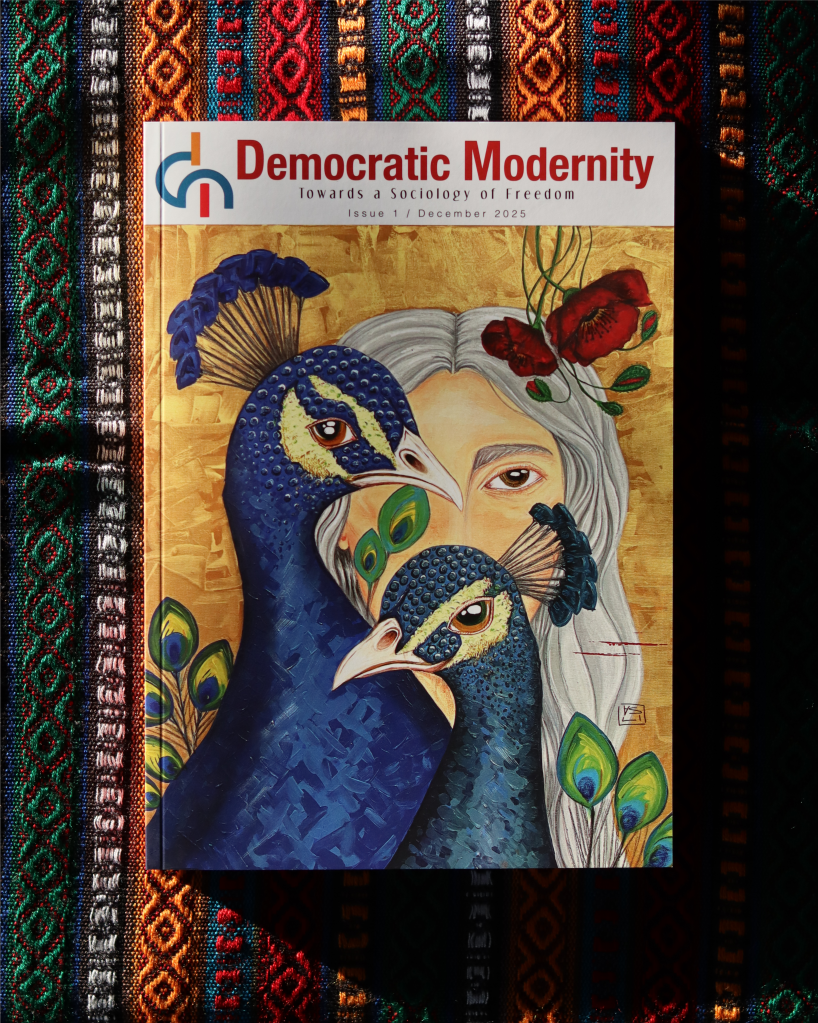
We end, therefore, with a call from our communes, towards the Commune. This journal is the organ of the Academy of Social Science: our aim is the development of a unified approach able to find the threads of democratic society, and to help in weaving these together with global movements, communities, intellectuals, artists, and all who see themselves as world-historic droplets in the river of democratic civilization. Our communes will focus on different parts of democratic civilization and society, but in each different area of research we have the same invariant focus on the already existing realities that form potentials for realising democratic modernity. Since everyday communism runs through all morality, ethics and political organisation, there’s no part of our shared democratic history beyond need of investigation, including the revolutionary experiences of the past two hundred years. But we refuse to be haunted by the ghosts of the twentieth century; they have earned their rest. A democratic civilizational perspective is an opening, a refusal of panic in this time of monsters, when the old world is dying and the new world still struggles to be born. Among the myriad morbid symptoms of crisis, the temptation is to call again for the failed messiahs and mahdis of capitalist modernity. But now is not the time to conjure their spirits, or to dress ourselves in their costumes. Now is the time to reclaim our historical agency, which has always come before that of state civilization, now is the time to see the eternal potential for millennia of freedom in the very fact of human sociality and culture. Another civilization is not only possible, it already surrounds us. We only need to recognise ourselves in its past, see its practical reality everywhere today, and recognise how our actions always already ripple through its depths into the future. And so we can hope.
References
1 Readers may recognise the influence of Ernst Bloch’s The Principle of Hope in the framing here, and can read more sustained engagement with his ideas in John Holloway’s contribution to the present issue.
2 Hope is essential to Antonio Gramsci’s famous maxim, ‘pessimism of the intellect, optimism of the will’, the necessity of an optimistic leap, the embrace of the moment of hope, in any revolutionary struggle.
3 Benedict Anderson, Imagined Communities: Reflections on the Origins & Spread of Nationalism (Verso, 1983).
4 Rosa Luxemburg, ‘The National Question and Autonomy’ (1908-9).
5 Immanuel Wallerstein, ‘1968, Revolution in the World-System: Theses and Queries’, Theory & Society, Vol. 18, No. 4 (1989), 431-449.
6 James C. Scott, Seeing Like a State (Yale University Press, 1998).
7 Perspective for the 12th PKK Congress.
8 Mark Fisher, Capitalist Realism: Is There No Alternative? (Zero Books, 2009).
9 Peter Kropotkin, Mutual Aid: A Factor of Evolution (1902).
10 Karl Marx, Capital: A Critique of Political Economy (1867).
11 David Graeber, ‘Communism’, in Keith Hart, Jean-Louis Laville & Antonio David Cattan (eds.), The Human Economy: A Citizen’s Guide (Polity, 2019).
12 Manifesto Vol. 3.
13 Perspective for the 12th PKK Congress.
14 Friedrich Engels, The Origin of Family, Private Property & the State (1882).
15 Manifesto Vol. 2.
16 Fernand Braudel, Capitalism & Civilization, 15th-18th c., Vol. I: The Structures of Everyday Life (William Collins Sons & Co. Ltd., 1979).
17 Perspective for the 12th PKK Congress.
18 Michael Hardt & Antonio Negri, Multitude: War & Democracy in the Age of Empire (Penguin, 2004).