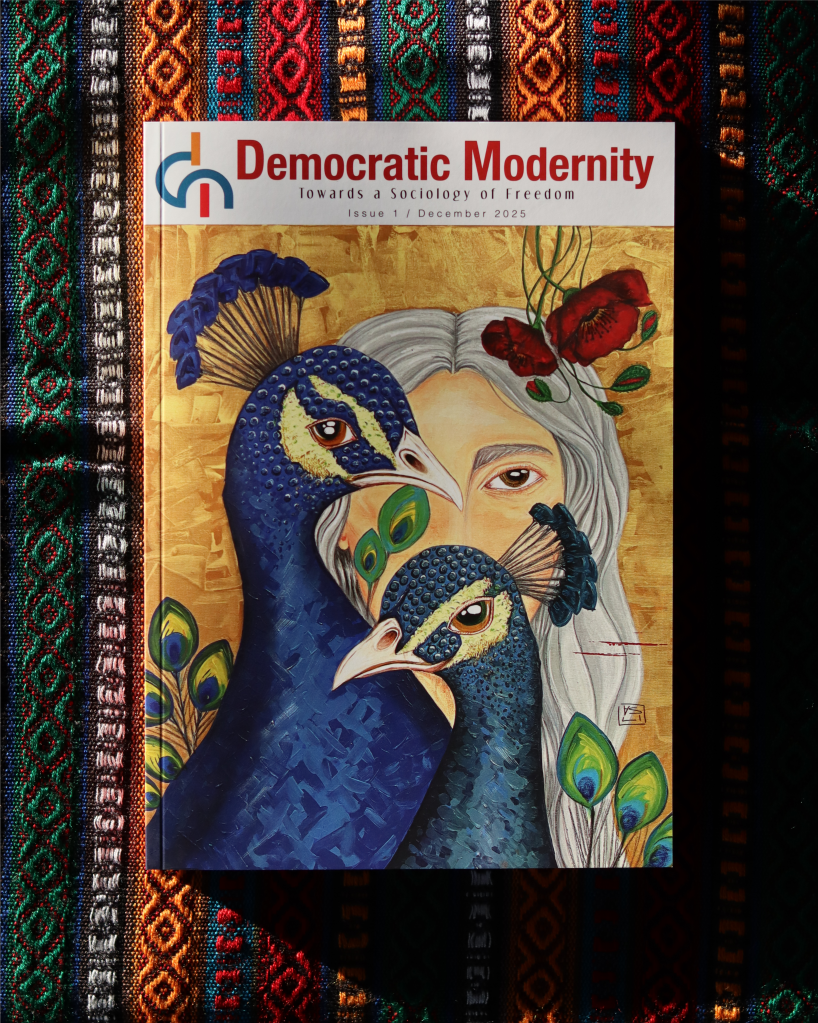

By John Holloway
I
Of all that I have read, probably the sentence that has helped and inspired me most is a comment made by Ernst Bloch in his Tübingen Introduction to Philosophy.
Alienation could not even be seen, and condemned of robbing people of their freedom and depriving the world of its soul, if there did not exist some measure of its opposite, of that possible coming-to-oneself, being-with-oneself, against which alienation can be measured (Bloch 1964 (2), 113).
A slap in the face for the depressing greyness of the left. Yes, we live in a world that robs people of their freedom, and yes, this is a society that deprives the world of its soul. Yes, yes, yes, capitalism is awful, an alienated world that kills us literally and figuratively. But to say that and not go further is a partial truth that is an untruth. Because it is only possible to say it if there exists “some measure of its opposite, of that possible coming-to-oneself, being-with-oneself, against which alienation can be measured.”
To simply denounce the awfulness of capitalism is a third-person untruth. To see the world in the third person is to start from a lie, simply because it excludes the observer, the speaker. By doing so, it attributes a false stability to that which is stated or observed. So, when Bloch says that the precondition for being able to talk of capitalism as a system of alienation is the existence of its opposite, the possible coming-to-oneself, he is introducing an instability into that characterisation of the world, he is already subverting it. He is saying that when we say that the world is alienated, there is something else that we are not expressing, namely the existence of the negation of alienation, namely the force of our own criticism of alienation, and it is this unexpressed or latent force that gives us hope.
The exclusion of the first person is the foundation of the traditional positivist or identitarian view of science. By excluding, or claiming to exclude, the first person, it attributes a stability to the phenomena. It attributes to them an existence independent of the subject, of ourselves. By excluding the subject, it dovetails with a system that is based upon the objectification of the subject, the reduction of us to the objects of alien determination.
This is the case not only for the thought that does not question the permanence of the existing system (bourgeois thought), but also for much of traditional Marxism. The wonderful first sentence of Marx’s Capital poses the issue clearly: “The wealth of societies dominated by the capitalist mode of production appears in the form of an “enormous accumulation of commodities.” This sentence is enormously important because it provides the basis for understanding the dynamic of the current system of social cohesion that is taking us ever deeper into catastrophe. But it is also misleading, precisely in the sense that Bloch indicates: the only way in which we can make that statement is if it also untrue. The subordination of wealth to the commodity form “could not even be seen, and condemned of robbing people of their freedom and depriving the world of its soul, if there did not exist some other” form of wealth or richness from which the domination of the commodity can be criticised. In order for us to say that wealth exists in the form of commodities, there must be some sort of misfitting or overflowing from the commodity form. Wealth is not totally subsumed to the commodity form: it exists also against-and-beyond that form.
We have, then, an identitarian and an anti-identitarian reading of the first sentence of Capital. In the identitarian (and almost universal) reading, wealth under capitalism is identical with the commodity (or money), it exists in the commodity form until, until the future revolutionary moment of emancipation. In an anti-identitarian reading, the relation between wealth and the commodity is never a neat fit, it is a constant antagonism. Revolution is not in the future but in current resistance-and-rebellion. For the future revolution, we need a Party, but for current resistance-and-rebellion we are talking of other forms of organisation.
We can say more generally that any denunciation of oppression necessarily means the existence of its opposite, some overflowing from that oppression. To denounce domination as if it were total is logically inconsistent and conceals from view the existence of the criticiser. If domination were total, we could not criticise it. An identitarian reading of domination as though it existed separate from resistance entraps us either in hopelessness or in the hope for an intervention of an external force, such as the Party or perhaps a god. An anti-identitarian understanding of domination that points to the inevitable overflowing that criticism implies, that “possible coming-to-oneself, being-with one-self,” immediately takes us to the all-important question of overflowing as present resistance-and-rebellion and how that resistance-and-rebellion can be strengthened.
II
It is becoming clear that Bloch’s statement has profound political implications. It points to the present existence of “that possible coming-to-oneself, being-with-oneself.” This is at the core of the two great rethinkings of revolution in the world today, the Kurdish Freedom Movement and the Zapatista movement.
Bloch develops the idea in his major work, The Principle of Hope, in terms of his central category of the Not Yet. The source of hope that we can break the catastrophe of capitalism lies in the present existence of the Not Yet, the present existence of that world which could exist, but does not yet exist: the world that does not yet exist exists not-yet. It exists as anticipation of a different world, as thrust-towards that world. He traces its latent force in fairy tales, dance, architecture, utopian thought, literature, music, religion, the many ways in which people push against the ugliness or alienation of the existing world towards a world of dignity, a world of mutual recognition. This breaks the homogeneity of time that is so stark in traditional revolutionary thought with its contrast between the horrors of the present and the joys of the post-revolutionary future.
The force of the Not Yet is latent. It exists not-yet, that is, it exists now, but in the mode of being denied, to take up Richard Gunn’s wonderful phrase. Truth and freedom exist as real force in this untrue, unfree society, but they exist in the mode of being denied. Richness, or wealth, exists too in the mode of being denied, that is, in the form of the commodity. In a beautiful passage in the Grundrisse (1857/1973, 488), Marx asks
“when the limited bourgeois form is stripped away, what is wealth other than the … absolute working-out of (Man’s) creative potentialities, with no presupposition other than the previous historic development, … where he … strives not to remain something he has become, but is in the absolute movement of becoming?”
And then he adds:
“In bourgeois economics — and in the epoch of production to which it corresponds — this complete working-out of the human content appears as a complete emptying-out.”
But we know from Bloch that this “complete emptying-out” can only be expressed if it is not a complete emptying-out. In other words, it would be impossible to write what Marx writes if richness, as Marx describes it here, did not overflow the commodity form, did not exist now as not-yet.
We find the same idea in the Zapatista category of dignity. Whereas the Leninist concept of revolution was based on the present containing of workers’ discontent within trade unionist militancy, which made necessary the existence of a revolutionary party to lead the way, the concept of dignity for the Zapatistas does not carry such a limitation.
In an early communiqué, they explain their uprising in terms of dignity:
Then that suffering that united us made us speak, and we recognised that in our words there was truth, we knew that not only pain and suffering lived in our tongue, we recognised that there is hope still in our hearts. We spoke with ourselves, we looked inside ourselves and we looked at our history: we saw our most ancient fathers suffering and struggling, we saw our grandfathers struggling, we saw our fathers with fury in their hands, we saw that not everything had been taken from us, that we had the most valuable, that which made us live, that which made our step rise above plants and animals, that which made the stone be beneath our feet, and we saw, brothers, that all we had was dignity, and we saw that great was the shame of having forgotten it, and we saw that dignity was good for men to be men again, and dignity returned to live in our hearts, and we were new again, and the dead, our dead, saw that we were new again and they called us again to dignity, to struggle. (EZLN 1994, 122)
A Zapatista statement, but I imagine it is equally true of the Kurdish freedom movement.
Dignity here is refusal now to accept a society that is constructed on the negation of dignity and the determination to construct now a society based on the mutual recognition of human dignities (and also respect for other forms of life). As in Bloch’s not-yet, the homogenisation of time, with its clear distinction between present and future, is broken. This is important because it breaks the traditional idea of Party-State Communism, in which the Party is present preparation for the seizure of state power which will take us into the future reorganisation of society. Dignity, like the Not-Yet, is that which does not fit into present domination, that which overflows into the present recognition-and-construction of a different world.
Recognition is crucial because it points us to the present existence of that different world that we want to construct. That which we want to construct already exists, albeit in the mode of being denied, it exists as latent not-yet, it exists in the base-line communism that David Graeber sees as the necessary substructure of any social cohesion, in the ubiquitous anti-pyramidal base that underlies the present social pyramid, as Massimo DeAngelis argues (2025). It exists in the anti-state and anti-patriarchal communalism of democracy that Abdullah Öcalan traces through history since the rise of the Sumerian empire. Listen becomes the basis of revolutionary thought and organisation, taking the place of the talk and explain of the old revolutionary tradition.
The state talks and explains, the commune listens and discusses. To recognise that “possible coming-to-oneself, being-with-oneself, against which alienation can be measured,” that dignity, that existing communism, that weave of underlying democratic modernity, necessarily takes us away from the state form of organisation to the commune, both as present form of organisation and as vision of how a future society should be organised, what Öcalan and the Kurdish freedom movement call democratic confederalism.
Listen to what cannot be heard, look for that which cannot be seen, be attentive to that which overflows from the categories, to the life that lives in-against-and-beyond itself. Is this the sociology of freedom?
III
In our moments of depression, domination seems to be total, there is no way out. But no: the very fact that we have a concept of domination or alienation or capitalism or state or capitalist modernity points us to the fact that there is more than that: that there is also a resistance-and-rebellion, a latent Not-Yet, a baseline communism, a dignity, a democratic modernity, a subterranean force that pushes in the opposite direction, a truth and freedom that drive against the untruth and unfreedom of capitalism. This is what gives us hope.
These two layers of reality cannot simply exist side-by-side. They are in constant antagonism. Domination and exploitation are not just the characteristics of an unjust society, they are a dynamic of dominating and exploiting directed against our wanting to live in the way that we determine. And our not-yet, our dignity are not just a way of doing things, they are a constant resisting-against and pushing-beyond the aggression of capital. This is class struggle — understood as the struggle in-against-and-beyond the society that classifies us — the totality of the clash between the dynamic of capital that is pushing us towards extinction and the constant drive of life, the drive not just to survive but to live. When we listen to the subterranean world of resistance, to the common, to the baseline communism, we are not just listening to a way of weaving life, we are listening to a weaving-against, a resistance-and-rebellion.
Take gardening, for example, the classic image of withdrawing from the world to do something useful and autonomous: it has become more and more clear that gardening is in fact a gardening-against, an activity that is part of the resistance-and-rebellion against the destruction of beauty and biodiversity. This is expressed openly in community gardens, but it has also become the declared aim of botanic gardens everywhere in the world. The same is true of agro-ecology or traditional small-scale practices of cultivation, indigenous or other: consciously or not, they stand in opposition to the destruction of biodiversity effected by agricultural business. Any sociology of freedom, of the underlying practices of communising or democratic modernity, that did not take the centrality of the unceasing social antagonism between money and life into account, would fail to do justice to the ubiquity of resistance-and-rebellion.
To come back to the initial quote from Bloch, it is important to realise that “the possible coming-to-oneself, being-with-oneself ” is not an escape from alienation but a resistance-and-rebellion against alienation. The same is true of hope, or truth, or freedom. Hope is grounded in the present existence of the Not-Yet, but it makes sense only when understood as hope-against, hope-against the capitalist dynamic of destruction. Truth too has its basis in the really-existing practices and dreams of everyday communising, but this is a communising-against and a truth-against the fetishised self-presentation of the world of commodities. The same is true of freedom: freedom is the ubiquitous struggle against unfreedom: it exists only as struggle against its own negation.
To see truth, freedom, communising, hope, as poles of an antagonism is at once a warning against romanticisation. In an antagonism, there is an interpenetration of the antagonists. We penetrate capital and constitute its fragility, but it is also the case that capital penetrates us who fight against it. There is no revolutionary purity. The identitarian thought that commodity exchange generates, penetrates communal organisation against its domination. There is no guarantee that communal organisation will reach good decisions: it can produce lynchings or racist or sexist exclusions of the other. It is better to recognise the dangers and contradictions of the commune, and to work them out through anti-identitarian communal discussion: there is no other path to truth and freedom.
IV
I write this article as part of an attempt to strengthen the Academy, our Academy, to make it grow by bringing together the preoccupations of the Kurdish Freedom Movement, the Zapatistas, and recent discussions in Marxist and critical theory: to strengthen our Academy-against, against the capitalist form of social cohesion that we are replacing and must replace with a different, communising form of coming together. It is an honour and a pleasure to write in this first number of the journal Democratic Modernity and to participate in the establishment of the new Academy of Social Science in Eindhoven. I am here because I think (along with millions of others) that capitalism is an intensifying disaster and that it is crucial for the future of humanity to get rid of the present social system and replace it with a form of human interaction based on communising and the mutual recognition of human dignities.
The state-centred revolutionary attempts to overcome capitalism in the last century produced horrible results and ended up strengthening the domination of capital, of money. Since the fall of the misnamed Soviet Union, there has been a radical rethinking in very many movements about what anti-capitalism means today. A number of features stand out: the creation of a different world has to be anti-capitalist, anti-state, anti-patriarchal, anti-racist and based on a different relationship with other forms of life and the natural environment in general. There are many movements and people in this rethinking of revolutionary hope, but there are two movements in particular that are playing an extremely important role in the practising and thinking of these possibilities. These are the Zapatista movement and the Kurdish freedom movement. I am in this journal and this Academy because I want to learn-understand-discuss how these movements and the many, many others are struggling to open up the world and create something radically different. I want to bring the discussions I have been involved in around zapatismo, critical and Marxist theory into the discussions of the Kurdish freedom movement and to introduce the debates of Öcalan and the Kurdish movement into wider discussions of radical and revolutionary theory.
We need more debates, more criticism of one another, not in the sense of “I’m right, you’re wrong,” but in the sense of “this is what I think, what do you say? Let’s sit down and have a cup of chai or a wee dram of whiskey together and discuss it.” The past aggressivity of debate has, I think, led to a situation where we are afraid to express our disagreements. But disagreement-and-debate has to be part of moving forward.
So let’s do it. I had already imagined the situation in my Preface to Öcalan’s Sociology of Freedom (a huge, huge, huge honour for me) and now that the brutality of his imprisonment by the Turkish state seems to be easing, let’s sit down and sip our chai and whiskey. “Right, Abdullah” (no disrespect in using your first name, and you are younger than I am), I say. “We know that I admire you enormously and that we agree on the most fundamental: the need to get rid of capital, the state and patriarchy and to recognise-and create a communising democratic confederalism. But that does not mean that I agree with you on everything, and we know too that you have been inviting criticism of your writings and perhaps not receiving as much as you would like. So let me start with a point that is fairly central to your argument in the piece “On Method and Regime of Truth.” You say there: “Truth is love; love is free life! Thus, if we are not filled with love for a free life — which is both the method to obtain truth and the regime of truth — then we can neither obtain the necessary knowledge nor build our desired social world.” Lovely! I agree completely. And then you go on: “Let us now examine the leading structures and knowledge in the light of this hypothesis. We start off by rejecting the progenitors of the Bacons and Descartes — taking the human being as our basis may be more appropriate than the subject-body, spirit-body dichotomy. I am not pleading for a human-centric world view, nor for a humanistic approach.” Right, I’m with you! But then you lose me when you continue: “I am referring to the totality of facts that comprises the human being, facts such as: (1) Atoms, the building blocks of matter, have their richest existence and composition — both in terms of number and arrangement — in the human being. (2) The human being has the advantage of representing all the plant and animal structures of the biological world. (3) The human being has realised the most advanced forms of social life. (4) The human being has access to a very elastic and free intellectual world. (5) The human being is capable of metaphysical thought.” And then you go on to develop these points over a number of pages.
“I find this argument difficult to follow. Partly because it takes me beyond my intellectual capabilities. But also because I don’t want to go in that direction. It reminds me of Engels’ attempt to give a natural-scientific grounding to the dialectic, and of Lukács’ rejection of that by saying that the dialectic must be understood in terms of the movement of human negation. In that, Abdullah, I am clearly on Lukács’ side of the argument. I feel that your argument takes us towards a positivisation of revolutionary thought which in the past has had dangerous consequences. I am in complete — or at least almost — agreement with the idea of “taking the human being as our basis,” but I would take that in a different direction. I say “almost” because I don’t like to talk of “human beings.” I prefer “humans,” because “beings” suggests that we are, it takes us into an identitarian approach to society. We are not human beings, we are human becomings. Not just that, we are frustrated becomings, forced into being contained as beings. Our becoming exists in the mode of being denied, as being, and therefore we are becomings in struggle against our own negation. I quoted Marx’s beautiful passage from the Grundrisse: “when the limited bourgeois form is stripped away, what is wealth other than the … absolute working-out of (Man’s) creative potentialities, with no presupposition other than the previous historic development, … where he … strives not to remain something he has become, but is in the absolute movement of becoming?” That is the point: the existence of wealth in the form of commodities is the negation of our “absolute movement of becoming” and life (life beyond survival) is the struggle to break through being in order to become. Life is the struggle to break through the form of social cohesion based on commodity exchange that contains us as beings and to create a social cohering, a communising that emancipates us as becomings. In other words, taking the human as our basis takes us immediately to a negative understanding of the truth of the world that starts from antagonism, from humans’ struggle against our own negation.
“But I am sorry, Abdullah, I am talking too much. What do you think of what I am saying?” Abdullah Öcalan pauses for a moment to take a sip of his chai, and then he says….
But my understanding of Öcalan is still too limited for me to invent his reply, so I am hoping that someone else will do it.
References
Bloch, Ernst. 1959/ 1985. The Principle of Hope (3 vols). Cambridge, Massachusetts: MIT Press.
Bloch, Ernst. 1963/1968. Tübinger Einleitung in die Philosophie (2 Bde). Frankfurt: Suhrkamp.
De Angelis, Massimo. 2025. “La Pirámide es inútil” in Crítica Anticapitalista, no.3., https://comunizar.com.ar/la-piramide-es-inutil/
EZLN Ejército Zapatista de Liberación Nacional (1994): Communiqué of 1 February: “Al Consejo 500 Años de Resistencia Indígena: que nuestros corazones junten sus pasos.” https://enlacezapatista.ezln.org.mx/1994/02/01/al-consejo-500-anos-de-resistencia-indigena-que-nuestros-corazones-junten-sus-pasos/ Also in La Palabra de los Armados de Verdad y Fuego (3 vols) (Mexico City: Fuenteovejuna)
Graeber, David. 2010. “Communism,” in The Human Economy: A Citizen’s Guide, edited by Keith Hart, Jean-Louis Laville and Antonio David Cattani, 199-210. Cambridge: Polity Press
Gunn, Richard. 1992. “Against Historical Materialism: Marxism as a First-order Discourse,” in Open Marxism Vol. 2. Theory and Practice, edited by Werner Bonefeld, Gunn, Richard and Psychopedis, Kosmas, 1-45. London: Pluto Press.
Hammy, Cihad and Thomas Jeffrey Miley. 2025. Rojava in Focus: Critical Dialogues. Chico, California: AK Press.
Lukács, Georg. 1923/1971. “What is Orthodox Marxism?,” in History and Class Consciousness, 1-26. Cambridge, Mass.: MIT Press
Marx, Karl. 1867/2024. Capital, edited by Paul North and Paul Reitter. Translated by Paul Reitter. Princeton: Princeton University Press
Öcalan, Abdullah. 2020. The Sociology of Freedom, Oakland: PM Press.
Öcalan, Abdullah 2015. “On Method and Regime of Truth,” in Civilization.