by Laura Fantone
Let us say that we are making several revolutions at the same time: the social revolution, the revolution of a democratic nation, the women’s freedom revolution and the revolution of self-defense. This is certainly not easy: not easy for women and men who, for hundreds of years, have been estranged to their culture, language and being, and for whom the relationship between men and women have collapsed terribly, drowned in slavery and oppression, and for the society, which has been left destitute of the need to defend itself and to re-create itself. (Yusuf 2020, p. 216)
One of the themes this journal will develop is the fundamental role of women, globally, in free, democratic modernity, as articulated by Abdullah Öcalan since the 1990s. The ideas and practices discussed here are particularly relevant because they are reflected in the Kurdish freedom movement, and now actualized in Rojava’s autonomous administrative region, under incredible historical circumstances.
Women are central here not only as political subjects able to create a communal horizon where life and freedom can finally thrive, but also as sources of anti-capitalist knowledge and democratic, communal values needed to develop a paradigm of modernity. To evoke Öcalan’s powerful statement:
The twenty-first century shall be the century of women’s liberation. I have full confidence that women, irrespective of their different cultures and ethnicities, and all those who have been excluded from the system will succeed (…) Giving support to women’s ire, knowledge and freedom of movement is the greatest display of comradeship, and a value of humanity. (2013, 60)
I plan to explore the rich dimensions of Öcalan’s reflections on women’s epistemology, politics and ontology, placing them in conversation with various feminist theories and practices, especially anti-colonial, eco and transnational feminisms, intended both as academic fields and, most importantly, force-fields where struggles transform the whole society, not only the male/female binary relations of power. I will discuss Öcalan’s Jineolojî in its affinity with various feminist ideas developed in oppositional, revolutionary stances, starting from the assumption that academic disciplines are always hierarchical tools for the colonization of knowledge, largely aimed at the reproduction of domination by silencing and separating subaltern wisdoms, especially those emerging from non-white, non-male bodies.
This premise is Gramscian, because it recognizes that the key role of traditional intellectuals is to maintain cultural hegemony, a complex process and struggle, in which the supremacy of dominant groups is legitimized by influencing common cultural values. I recognize that the mechanism described a century ago is still in place in universities, art, media, even when minorities are invited by the élites to express their difference and criticisms. Gramsci’s reflections on hegemony made clear the distinction between what we could define “mainstream intellectuals” and “organic intellectuals,” the ones he was evoking as necessary, after the Bolshevik revolution: those who express subaltern ideas, those who support and help articulate counter-hegemonic beliefs and practices rooted in the experience of the oppressed. Those we are inviting to join in this journal.
Gramsci believed that it is fundamental to construct an intellectual-moral bloc which can make politically possible the intellectual progress of the masses and not only of small intellectual groups (Notebook 11). This journal is inspired by the same goal, as its aim is not to become a new journal for highly trained experts on Mesopotamian political history, Öcalan, or the possible forms of democracy.
It rather aspires to become an organic space of intellectual and moral progress towards freedom for all the subalterns to engage with, starting from the Kurdish freedom struggle.
A Gramscian emancipatory social science
It is key to remember that Öcalan’s writings are designed to be accessible to a large, politically active audience scattered across locations, and in his writing style there is a clear Gramscian element, sometimes makes it difficult for mainstream disciplines and “traditional” intellectuals to engage with. If we take the definition of Gramsci’s “organic intellectual,” as someone who articulates counter-hegemonic ideas and values, and exposes contradictions of the existing social order, Öcalan fits it. The organic intellectual’s role is to divulge critical views so powerful as to challenge common sense and produce new widely accepted values that can spark revolutionary changes, by instigating a crisis in consent that cracks the foundations of dominant groups and their cultural hegemony. Öcalan’s five volumes on democratic civilization continue to inspire change in the practices of the Kurdish movement, their relations to a political party of workers, to the now surpassed aspiration to nation-state status, to autonomy, and self-defense.
In this sense, I consider Öcalan both a strong movement leader and a true organic intellectual of great relevance today, in agreement with a well-known statement by Tony Negri, Italian Marxist intellectual and movement leader from the 1970s. It not a surprise that Negri, also imprisoned and accused of armed insurrection and terrorism, saw a strong analogy between Gramsci and Öcalan. Negri defines Öcalan
An Antonio Gramsci for his own country. An example for everyone (…) a man in jail, but still capable of developing a thought that destroys all closures, a political leader who continues to produce and renew an ethical and civil teaching for his people. (2020, 49)
Some similarities with Gramsci are undeniable: both came from a rural periphery, where they witnessed absolute misery and oppression. They later moved to a big city to study and founded a political party. They both were forced to leave and move across various borders to pursue their political project. Both kept reading and writing incessantly during their years of detention; both used a variety of sources, some highly theoretical, and other based on everyday life, and common sense. Gramsci elaborated prefigurative ideas of a revolutionary moment he never stopped fighting for until his last breath, despite almost a decade of isolation in an unhealthy prison.
Öcalan keeps writing and speaking about the realization of freedom and democratic modernity, after twenty-six years of imprisonment, connecting activists globally. Despite the Turkish authorities’ determination to deny him every chance to speak to the Kurds who consider him their leader, Öcalan brings theory and practice together in writing, the only tool legally available to him. Similarly, the Italian Fascist authorities removed Gramsci’s voice as a party leader and international public figure, confining him to a remote prison in Apulia, far from any city or contact with his community. Out of these extremely limiting conditions, as well as precise political choices, Öcalan’s writings emerge as an inter- disciplinary rich tapestry, with a deep political and organic texture.
David Graeber described how these qualities, which could also be found in Gramsci’s Prison Notebooks, create some level of discomfort in intellectual circles of various kinds: Marxists, anarchists, academics, and all scholars alike (See Öcalan as a Thinker, 2020). Graeber’s point on Öcalan’s extreme trajectory as an intellectual and revolutionary, as a cause of academic skepticism and avoidance of Öcalan’s writings, resonated with my initial doubts about Sociology of Freedom (2020).
Doubts and Distinctions
As an academically trained sociologist, I confess that I initially did not trust Öcalan’s utopian view of the role of an “organic” political sociology, in contrast with mainstream sociology, a well-established, Western discipline, which mostly produces policy suggestions and data used within the defined boundaries of capitalist and state institutions.
Certainly, inside such confined discipline, there has always been some social research on marginalized groups (factory workers, immigrants, women care givers, the poor, queer and trans, sex workers, and so on) useful for understanding the shifting landscape of hegemonic ideas and shaping counter-hegemonic narratives to make the subaltern more accepted. Ultimately, Öcalan’s Third Volume of the Manifesto of Democratic Civilization, titled Sociology of Freedom (2020), seems the most relevant when outlining the contrast between capitalist modernity, with its positivist epistemology, and democratic modernity. I consider the most innovative parts of the book the sections where he veers away from sociology in the strict sense, to open a dialogue with social movements, then outline his vision, more utopian than sociological (Chapters 7 to 10). I also wondered about the need to create a new, non-positivist, non-liberal, social science of women, when I first read about Jineolojî, a new social science, with a defined research field and a set of theories grounded in the body of knowledge of women, able to contrast Western, dominant social sciences and move past their limited analysis of women and gender minorities.
There is another dimension of discomfort I initially felt about Öcalan, unrelated to his writings on sociology: the fact that he is an icon. Negri noted that Gramsci and Öcalan are organic intellectuals, with roots in Marxist politics, and, in their intense life of struggle have become icons, respected and revered across time and space. Negri describes Öcalan as “mythical,” and Graeber points to the tension between anti-authoritarianism in Öcalan’s writings and the “classic revolutionary cult leader” quality he embodies (2020).
My anarchist political stance maintains some skepticism on the patriarchal structure of many social movements, even the ones who preach equality, especially around the iconography of the great man leader, with his messianic voice and role — from Jesus to Che Guevara, to Tony Negri (less known but still revered in Italian circles as the male master/prophet). However, there is unique trait that differentiates Öcalan, as Graeber argues (2020), from the above: his adoption of an egalitarian, anarchist and eco-feminist view, spanning over the last two decades while maintaining the role of the leader in exile. This places him in the paradoxical position of symbolizing the Kurdish liberation party, embodying the past struggles of the PKK1, and its destiny, while at the same time trying to diminish his own authority. A leader/icon who tries intentionally to shed his charismatic power is courageous and a historical singularity, especially given his vision to create a distributed, democratic confederalist, egalitarian social system based on autonomy, democratic councils, cooperatives, unions, women’s assemblies and shared co-leadership. All measures designed not to rely on a central leader and ideologue, but rather to share power horizontally.
After reading Öcalan’s Liberating Life: Woman’s Revolution (2013), and visiting Rojava, I realized that there is room for both for a cult-leader iconography, an inspirational figure, with almost supernatural qualities, symbolically protecting the precarious spaces of the DAANES region2, liberated with blood and sweat, and a healthy, constant critical engagement with Öcalan’s writings, even when the founder father of such a strong political organization asks the leadership to abandon the party form and take on other forms of struggle.
My feminist critical studies lead me to consider Öcalan an “ally” in contemporary parlance, since he defined the feminist movement the “most radical anti-systemic movement” (2020), but he also pointed to women’s studies as a tool to relieve the pressure of state and capitalism, rather than appreciating their role in gender struggles. I accepted his ally positioning, while wondering what events and readings might have brought him to develop such a strong position on the centrality of women for the Kurdish and anti-capitalist liberation.
Öcalan is an interesting ally, precisely because he writes to inspire Kurdish women’s liberation as a man, who grew up in traditional family context and openly called for a sexual rupture, and a collective change in all gender roles. A striking point in Liberating Life (2013) related to the male ally is the slogan “kill the man,” a powerful way to end patriarchy, by starting with changing oneself. His analysis of male power and the actions needed to destroy the old patriarchal gendered forms of domination, resonates powerfully especially because written by a Middle Eastern man, who takes on the difficult task of undoing his own role as the male leader. A full rejection of hegemonic masculinity, in its physical, epistemic, and symbolic violence, challenges the male Kurdish movement leaders to do the same, directly inviting them to kill the (practice and ideology of) dominant men.
Along similar lines, he considers women the foundation of democratic modernity and calls for an active rejection of housewifisation, both by men and women, asking them to fight the hegemonic mechanism of compliance under capitalism, those internalized behaviors that paralyze women, youth, children, minorities (and one might add domestic animals) by way of spatial control, social barriers and enclosures aimed at limiting their bodies and minds. At the root of these powerful calls, we can see the desire to connect with common women’s experiences, to evoke an alliance across subaltern subjects, able to reconfigure life and freedom by way of changing daily life practices from below.
Jineolojî: Reconnecting free life to emancipatory social sciences
In the 2013 Liberating Life pamphlet, the organic intellectual starts a critique of the thousands year old hegemony of patriarchy, and proposes the counter-hegemonic project of Jineolojî: a revolutionary epistemological paradigm, a new field of research, based on women’s experience aesthetic and ethical stance. Jineolojî investigates women, the culture they create, the reflection on the historical societal models based on three concepts: life-woman, nature-woman, social-nature-woman (Kırmızıgül 2020, 82), braiding together all aspects of life. It is rooted in Mesopotamia spatially and politically in the Kurdish women’s freedom movement, and their efforts to reach forms of horizontal distribution of power in a democratic modernity to come (Düzgün 2016). The assumption is that gender equality plays a leading role for any revolutionary, social and political change: “without the freedom of women within society and without a real consciousness surrounding women, no society can call itself free” (Öcalan 2013, 62).
In the following section I outline some aspects of Jineolojî that stand out and bring a unique analytical and political perspective emerging from its specific historical and geographic origins, with the conscious goal of listening to the voices of Kurdish women and their allies, and honoring the places where this new field seems to be resonating the most.
Starting from the first colony, freeing the self (xwebûn)
In Sociology of Freedom, Öcalan acknowledges that feminism is the strongest anti-systemic expression of rebellion in women — the first colony. He also points to the limits such powerful movement encounters within capitalist modernity (2020, chapter 9). The liberal focus on legal gender equality, which conceives of freedom as individual choice, maintains feminist struggles within a patriarchal, capitalist frames, proved to have major weaknesses. Above all, a glaring paradox: women gained some grounds individually, and yet societies became increasingly unequal. This is what Jineolojî leaves behind, as a new social science historically and spatially rooted, whose goals include rethinking political participation of women, autonomy and self-defense, sexuality outside of capitalist objectified bodies, the pursuit of a free and equal partnership in life, politics and affect, detached from property, ownership and reproduction.
Self-defense (xwe-parastin) is another important foundation, deeply connected to the Kurdish freedom movement, rooted in ethical values of the cultivation of a revolutionary self (xwebûn) in relation to communal, solidarity, in sharp contrast with a Western, individualist sense of self.
These elements are fundamental women’s contribution to the larger Kurdish freedom struggle (Dirik 2022). The women’s revolution in Rojava reflect such values in its practices and political figures: the YPG and YPJ (self-defense forces)3, the asayisha jin4, as well as the figures of the mother, the grand- mother, the politician, the şehîd. Women and youth’s role in armed struggle is fundamental for revolutionary self-development and for community autonomy, so much so that the female guerrilla becomes a key figure uniting youth and women in the ultimate political horizon of freedom (Üstündag 2023). The central role of women, their self-defense and freedom also contain sub-themes of purity, separatism, sacrifice for the community, and martyrdom, especially in relation to women fighters in Rojava, and other female militants across the Kurdish regions (Käser 2021).
The connection between an absolute horizon of revolutionary change is exemplified by a powerful quote by Fawza Yusuf:
As people from this sacred, ancient land, we shall build our free, equal and democratic life, no matter what the price we must pay shall be. (2020 p. 216)
Üstündag describes the complex dimensions of key female figures (the mother, the guerrilla fighter, the politician), and their role connecting past oppression and a democratic future. I hope this journal will be a welcoming place for nuanced conversations on purity and autonomy as emerging values, to address their implications and potential application in other contexts of gender struggles.
Jineolojî also develops a vision of ecological, egalitarian society in which resources and knowledge are distributed to all, inspired by matriarchal societies. In Yusuf ’s quote and in Öcalan’s writings, the land as material and symbolic site of resistance figures prominently, as the terrain from which we can reimagine a free life, where resources and power distribution is equal, and women have a key role in politics, in social reproduction, and in the commons. In this horizon, the fertile land of Mesopotamia, with its ancient history, takes the symbolic role of a female supernatural force, protecting its inhabitants, the revolutionary women, who, in turn, protect the land, and honor her with their ecofeminist projects, developing a model to sustain life — not accumulation of wealth and power in the state form.
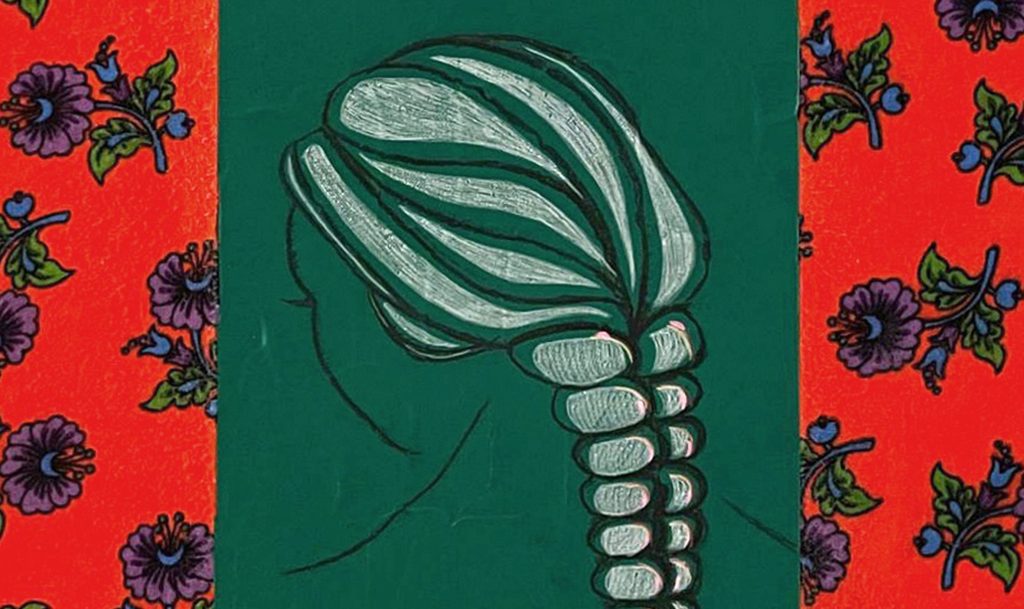
In this symbolic mutual inscription the material and symbolic role of the land is strong; in Jinwar, the village of free women, managed as a commune, and in many images recurring in Jineolojî publications: the wheat and the hair braid, the woman body emerging from a tree, the healing powers of river water, granting fertility and abundance, the folkloric myth of Shahmaran, who embodies the human female and snake figures, with their knowledge and wisdom.
Women as symbols of matriarchy in Mesopotamia and elsewhere become key elements for a utopian aesthetic and ethical imagination in Kurdish women’s struggles, connecting the past with future hopes. This resonates with the Gramscian cultural mission of celebrating folkloric, counter-hegemonic images and ideas, and distributing them to contrast dominant paradigms.
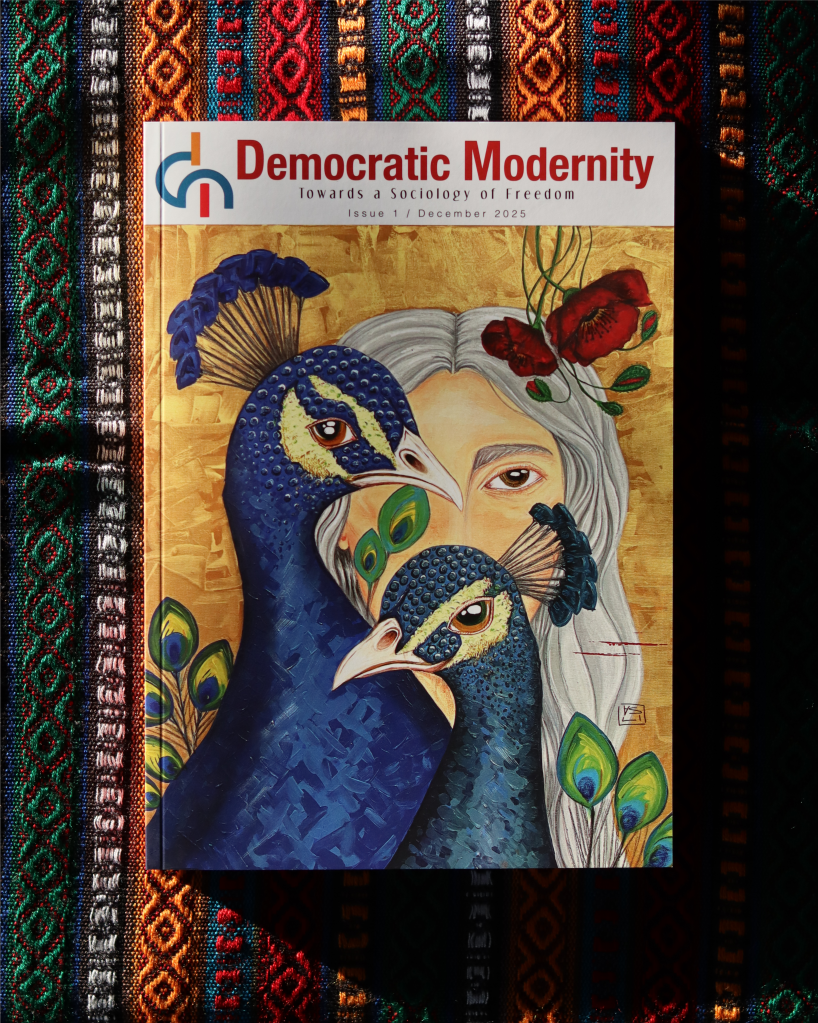
Jineolojî, among other themes, develops strong critiques of Western images of women, and capitalist media objectification: stereotypes which still work today, with imposed religions, and other forms of cultural colonization, to trap Middle Eastern women in orientalist images tied to a pre-democratic, ancient time, intentionally distanced from a political horizon of freedom, autonomy and self-defense (Käser 2021). This gives a sense the important political dimension of the work of artists and folk images created organically by the Kurdish freedom movement members, some of them reflected in this journal’s aesthetics as well.
In conclusion, Jineolojî as a comprehensive counter-hegemonic field and scientific approach, becomes the universal connector in the Sociology of Freedom — bringing together all anti-systemic forces and centering the fundamental tasks of building democratic modernity starting from new gender roles (Guneser 2021). Above all, Jineolojî contains many tools and anti-systemic issues, shared by multitudes of marginalized subjects, who can create key alliances to undermine the vicious relations of positivistic science with capitalism, patriarchy and the nation.
In the rest of this article, I plan on drawing connections between the Kurdish women emancipation, their gendered political practices, theories and methods, with the goals of placing Western feminist scholarship in dialogue with the Kurdish freedom movement. More broadly, my goal is to bring to life connections across those revolutionary movements which envision freedom in the most absolute, yet concrete utopian sense. A quote by Hevin Tekin reflects this internationalist spirit:
Let us go beyond a solidarity with Rojava. Let us also make the struggle in Rojava our own struggle. (2020, 88)
Feminist interlocutors: anti-systemic forces
In the previous section I summarized key themes in Jineolojî, with the hope that this journal becomes a space for an open dialogue with important gender theories and social movements focused on women, to explore new visions of women’s revolutionary roles in democratic modernity. More specifically, for this section of the journal, it would be fruitful to flesh out some ongoing dialogues with a few feminist political projects defined as anti-systemic forces by Öcalan: radical feminists, autonomous, Marxist feminist theories and practices, ecofeminism, and de/anti-colonial and transnational gender struggles.
It is worth recalling that historical emergence of such movements dates back to the 1960s and 70s, the moment of a first democratization of academia in Western nations in response to mass movements and protests. When this counter-hegemonic language emerged, it was aimed at giving voice and agency to the marginal, oppressed groups, to change the world. With that utopian goal, they attempted to make academia useful to a revolutionary project of emancipation of workers, women, racial and ethnic minorities, nature and the non-human animal, the place for an anti colonial pedagogy, and the democratization of science against techno capitalism.
In retrospect, it appears that such attempts have often been coopted (hooks 1996) or assimilated into new academic disciplines and fields of expertise, gradually removed from social movements (with the creation of departments of Labor Studies, Women’s Studies, Cultural Studies, Ethnic and Race Studies, separated research fields of Postcolonial and Decolonial Studies, Critical Science and Technology Studies). Despite their divisions and mainstreaming, we consider these relatively new interdisciplinary spaces, always already under attack, uniquely relevant interlocutors for this journal. Jineolojî and the “sociology of freedom” could open a new space that reconnects critical fields to concrete struggles, outside of the ivory tower’s self-referentiality, by and for scholars only.
Regarding feminism, Öcalan’s writings, in Sociology of Freedom (2020), point to the limits of gender politics developed within liberal-capitalist universities and social relations, in which empowering often means acquiring merely legal, individual rights, some access to capital and commodities, yet remaining tragically unable to reach a non-hierarchical, communal horizon of equality for all (chapter 9). This critique was also expressed by Nancy Fraser, who defined liberal feminism as the handmaiden of capitalism (2013). Öcalan believes that women’s freedom and equality require a program, an organization and a set of actions, more than a legal or discursive change; in this sense, he denounces the limits of academic feminism, detached from a far-reaching revolutionary project. This vision is guiding the Kurdish women’s freedom movement, rooted in a context of heavy repression, and developed over decades of resistance based on self-defense and autonomy (Dirik 2022). Öcalan’s views resonate deeply with other kinds of anti-systemic feminisms, especially around ecology, religion, sexuality, and reproductive labor.
Ecofeminism and Marxist feminist critiques of science. Critiques of technoscience and agribusiness as extractivist of communal, female knowledge and practices of self-subsistence (Haraway, Mies and Shiva 1983, just to mention a few) are echoed in Öcalan’s writings, especially in the interconnectedness of complex systems sustaining life: water, plants, climate, and the role of women in agriculture and biodiversity.
Anarcha-feminists’ refusal of monotheistic religions power, together with the state, the nation and capitalism as co-constitutive oppressive structures (Louise Michel, de Cleyre, Goldman) resonates with Öcalan’s core concept of “killing the dominant man” to liberate life (hooks 2004).
Radical feminist critiques of the colonization of the body, sexuality and women’s knowledge and skills (Rubin, Rich, Firestone), especially in dialogue with the powerful concept of housewifisation used by Öcalan. The practices of separatism, developed in the 1970s and 1980s do resonate with the call for the need of independent female spaces, exemplified by Jinwar, the YPJ, and women’s councils in Rojava.
Marxist feminism, especially on the value of reproductive labor and care work. The critique of patriarchy puts in dialogue women as “the first colony” and type of slave, not the last exploited worker in a post-industrial frame (Mies 1986). Also, Marxists feminists, drawing from Friedrich Engels’ critique of the private property and the state, pointed to family as a persistent shackle, across all forms of capitalisms, functional to maintaining the power of patriarchal dynasties and the law (James 1975). Along similar lines, in Sociology of Freedom, Öcalan states that women are laborers and colonized subjects:
the most often unpaid or, at best, minimally paid laborers, in keeping with male-dominant history, are nothing but objects. It is clear that the class that is being analyzed is the male (working class) (… ) The extreme colonization that women have experienced not only in terms of labor but also all of their bodies and souls has not been analyzed. (2020, 169)
Autonomist feminist critiques of the state, and the need to build power from below. In Öcalan’s vision women play a key part for their ethical stance and valuing life, leading the way towards democratic autonomy for the entire society. Their organic communalism is in opposition of the state, and its historical trajectory expanding demographic control: regulating population growth by regulating women’s bodies, overthrowing matrilinearity, invalidating female knowledges and isolating mothers in individualized relations of dependency from the husband (with monogamy), the state and its welfare institutions (Dalla Costa 2021, del Re 1996, Federici 1975, 2004).
Not surprisingly, in Sociology of Freedom (2020) and the Liberating Life pamphlet (2013) Öcalan’s arguments also resonate deeply with transnational, anti-colonial feminism. Mechtild Exo, a German anti-war feminist, explains well the resonance between anti-colonial feminism, feminist critiques of science, and the important contribution of Jineolojî as a transnational, interdisciplinary field, able to resonate in time and place, because deeply rooted in practices of equality and autonomy, as part of larger political projects (Exo 2020).
For many years, Öcalan expressed a comparative, transnational critique of the colonial and the post colonial power structures oppressing women, specifically connecting his analysis to the situated experiences of Mesopotamian women, and the transnational Kurdish women’s freedom movement (Dirik 2020). These theories and practices play an inspiring role today, in dialogue with situated indigenous and other anti colonial movements centered on women and their specific knowledges (Salem 2023). The Kurdish women’s freedom movement intersects with various indigenous organic intellectual contributions, especially by envisioning a revolutionary change that decolonizes the entire society.
In this light, Öcalan could be considered an ecofeminist, anti-colonial organic intellectual. He envisions a new critical discipline, Jineolojî, as a unifying social science rooted in women’s life, ethics and politics, aiming at communal freedom and autonomy. In his writings he offers an interesting way out of coopted, academic discourses written by intellectuals for intellectuals, full of Eurocentric theoretical bias, and opens the door to an intersectional, ambitious epistemological and political project, aimed at changing the world starting from gender. Many organic intellectuals and activists already contribute to Jineolojî, inspire by the Kurdish community values and its organizing capabilities.
This article is a modest attempt to expand support to such collaboration, by opening a space for discussions that waive together the main areas of Jineolojî with other themes developed by gender scholars, amplifying and strengthening the path of rebellion of the oldest colony (the term Öcalan uses to refer to women’s ancient oppression).
Open questions and themes for a decolonizing, transnational intellectual project (not a conclusion)
In this journal, we (the editorial commune) invite political activists and thinkers, artists, and any organic intellectuals to explore key moral, epistemological and political questions, broadly connected to analyses of scholars and allies who focus on critical fields of knowledge, those whose writing is aimed at eradicating patriarchy, capitalism, to democratize political institutions, to fight colonization, extraction, gender hierarchies and other dominant power structures (from racist, speciest, to ableist, heteronormative, and more). With the goal of connecting an- ti-systemic forces and critical studies, methodological frames, while also increasing the appreciation and visibility of the Kurdish freedom movement’s ideas and practices, we propose here an initial list of questions, inspired by the Jineolojî Academy’s work carried out, mainly by Middle Eastern women. The following list of themes can only consider provisional, of interest for future issues of the journal, which remains open to detours, meanderings, like a river, to reflect changes brought by new historical events, emerging desires and political urgencies.
Society and Care
We invite comparative analyses and critiques of various forms of reconfiguration of the family across revolutionary space. More specifically, we ask, what does a fair, communal form of reproductive labor look like in a revolutionary, gender-equal society? What are the most innovative ways in which reproductive labor is carried out in Rojava? What methods for educating men, women, and all genders, can be used to abandon traditional male/female roles, stifling sexual identities? We would like to compare successful examples from the Zapatistas, Rojava, and other revolutionary societies.
Autonomy, Intimacy and Community
We invite reflections and analyses, grounded in social movements, able to draw nuanced interpretation of sexual freedom, offering a variety of forms of women’s autonomy, exploring diverse practices in communal partnership. More specifically, I pose the question: how does the freely chosen companionship model proposed in the Kurdish context, as detached from property, family, and sexual power of one person over the other, translate in other cultures/movements?
Women, Life, Ecology
We need to open the vast, complex question of what does woman stand for? What are the gains and drawbacks of assuming a strategic essentialist notion of the woman, the mother, of nature, as core ethical figures, deeply connected to life and freedom in revolutionary democratic modernity? How do these figures change and become multiple while maintaining a powerful essence?
Escaping Gendered and Generational forms of Domination
Another, classic question in social movements is: how can the minoritized, excluded youth and gender minorities overthrow an established system, often dominated by older generations, attached to their wealth and power? Thinking of Rojava and DAANES specifically, a question arises: how can democratic modernity foster new institutions without recreating hierarchies over time?
It is time to seriously consider persistent mechanisms in gender and generational power, not only as reflected in old patriarchal systems but also in the resurfacing of an unapologetically patriarchal, cruel techno-capitalism, paired with new forms of charismatic power enabled by digital platforms where people create and share content, without any real social interaction (a fundamental paradox of the misleading term “social media”). What escape routes can we open for the colonized, the child, the queer, the servant, the domestic animal, being enclosed, frozen in space and time, legally silenced and controlled in their body? How to develop political tools for the rejection of housewifisation and domestication across political communities?
Starting from these premises, the journal invites anyone interested in democracy, autonomy and freedom to explore the questions listed above.
As a non-conclusion, it is important to remind ourselves that the conversation wishes to remain centered around the dialogue with the Kurdish women’s freedom movement, taking place in a highly volatile geopolitical context, against the larger backdrop of expanding wars, and the morbid symptoms of the capitalist death machine.
The Kurdish Freedom Movement regards women as the first colony and sees the enslavement of women through the institution of patrilineal family as intrinsic to the formation of capitalist modernity. According to this view, today, this history of colonization continues through a third world war, which is characterized by an attack to all social and communal forms of life. Genocide, societycide, politicide and femicide; the annihilation of people and their culture, the robbing of their means to reproduce themselves autonomously, the exclusion of them from politics by criminalization and the systematic killing of women in other words, are primary ways in which this war plays out. (Üstündag 2025)
This quote is taken from a powerful piece featured in this issue of the journal.
I hope this will spark the desires and energy to meet the political needs of a sustained struggle against such a dark horizon, with all our intellectual, moral and communal skills, to speak in the vicinity (as Algerian feminist Assia Djabar would put it), in support of women, life and freedom.
References
Jineolojî Academy Archives online http://jineolojî.eu/en
bell hooks, 2024. The Will to Change: Men, Masculinity, and Love. Simon and Schuster.
Benhabib, Seyla. 1995. Feminist Contentions. Routledge.
Dalla Costa, Maria Rosa. 2021. Family, Welfare, and the State: Between Progressivism and the New Deal. PM Press.
Dalla Costa, Maria Rosa. 1996. Donne sviluppo e lavoro di riproduzione. Questioni delle donne e dei movimenti. Franco Angeli.
Dirik, Dilar. 2022. The Kurdish Women’s Movement: History, Theory, Practice. Pluto Press.
Düzgün, Meral. 2016. “Jineologî: The Kurdish Women’s Movement,” Journal of Middle East Women’s Studies. Duke University Press, vol.12 (2). https://muse.jhu.edu/article/625064
Exo, Mechtild. 2020. “Making Connections” in Building Free Life, Dialogues with Öcalan. PM Press.
Federici, Silvia. 1975. Wages Against Housework. Falling Wall Press.
Federici, Silvia. 2004. Caliban and the Witch: Women, the Body and Primitive Accumulation. Autonomedia.
Federici, Silvia. 2018. Re-enchanting the World: Feminism and the Politics of the Commons. PM Press.
Fraser, Nancy. 2013. Fortunes of Feminism: from State-managed Capitalism to Neoliberal Crisis. Verso Books.
Graeber, David. 2020. “Öcalan as a Thinker: on the unity of Theory and Practice as a form of Writing” in Building Free Life, Dialogues with Öcalan. PM Press.
Gramsci, Antonio. Prison Notebooks, Vol. 1 (1992), Vol. 2 (1996) and Vol. 3 (2007), ed/trans. Joseph A. Buttigieg. Columbia University Press.
Guneser, Havin. 2021. “The Rebellion of the oldest colony- Jineolojî, the Science of Women and Life” in The Art of Freedom: A Brief History of the Kurdish Liberation Struggle. PM Press.
Heider, Reimar. 2020. “Democratic Nation: Defining ‘Nation’ Beyond the Borders of Patriarchy” in Challenging Capitalist Modernity III. International Initiative Edition.
International Initiative editors. 2020. Building Free life: Dialogues with Öcalan, PM Press.
James, Selma. 1975. The Power of Women and the Subversion of the Community. Falling Wall Press.
James, Selma. 2012. Sex, Race and Class — the Perspective of Winning: A Selection of Writings 1952–2011. PM Press.
Käser, Isabel. 2021. The Kurdish Women’s Freedom Movement: Gender, Body Politics and Militant Femininities. Cambridge University Press.
Kirmizigül, Haskar. 2020. “The Geist of Democratic Civilization” in Challenging Capitalist Modernity III, pp.81-87. International Initiative Editions.
Mies, Maria. 1986. Patriarchy and Accumulation On a World Scale: Women in the International Division of Labour. Zed Books.
Mies, Maria and Vandana Shiva. 1993. Ecofeminism. Zed Books.
Negri, Antonio. 2020. “A prisoner who is becoming mythical” in Building Free Life, Dialogues with Öcalan. pp. 49-54. PM Press.
Öcalan, Abdullah. 2013. Liberating life: Woman’s Revolution. International Initiative Editions.
Öcalan, Abdullah. 2021. The Sociology of Freedom, Manifesto of a Democratic Civilization, vol. III. International Initiative Editions.
Öcalan, Abdullah. 2022. Beyond State, Power, and Violence, PM Press.
Tekin, Hevin. 2020. “YXK closing speech” in Challenging Capitalist Modernity III. International Initiative Editions.
Üstündag, Nazan. 2023. The Mother, the Politician, and the Guerrilla: Women’s Political Imagination and the Kurdish Movement. Fordham University Press.
Wright, Steve. 2002. Storming Heaven: Class Composition and Struggle in Italian Autonomist Marxism. Pluto Press.
Yusuf, Fawza. 2020. speech for the 3rd conference “Challenging Capitalist Modernity”. International Initiative Editions.
- Kurdistan Workers’ Party, founded in 1978. ↩︎
- Democratic Autonomous Administration of North and East Syria, established in 2018. It includes over 25% of the Syrian territory and more than two million inhabitants. ↩︎
- YPG, People’s Defense Units, and the female YPJ, Women’s Protection Units, all formed by volunteers of various backgrounds. ↩︎
- Women’s internal security, similar to a police force in the DAANES region. ↩︎