by Reimar Heider
The establishment of a new academy like the Academy of Social Science raises all sorts of questions: What is an academy? Why another academy? Do we need academies? And if so, what for? I will try to shed some lights on these questions on the background of the experiences of the Kurdistan Freedom Movement and its tradition of academies.
The Tradition of Education in the Kurdistan Freedom Movement
One of the most ingrained traditions of the Kurdish Freedom Movement is the deep emphasis on education. It is no surprise, since colonialism that had almost successfully wiped out Kurdish history, culture and identity and it relied heavily on the education systems of the nation states that were not only silent about these issues but actively denied their existence or distorted reality in manifold ways. Therefore, distrust in the education systems of the nation states has been in the DNA of all movements of the Kurdish renaissance, and especially the movement that eventually formed the PKK, focused on researching and educating people on the buried history of Kurdistan as well as education in general. In the tradition of this movement education means that everybody learns reciprocally, independently of previous school education or the lack thereof. There is no separation of teachers and students, everybody will get included into at least one teaching group and learn while teaching and teach while learning.
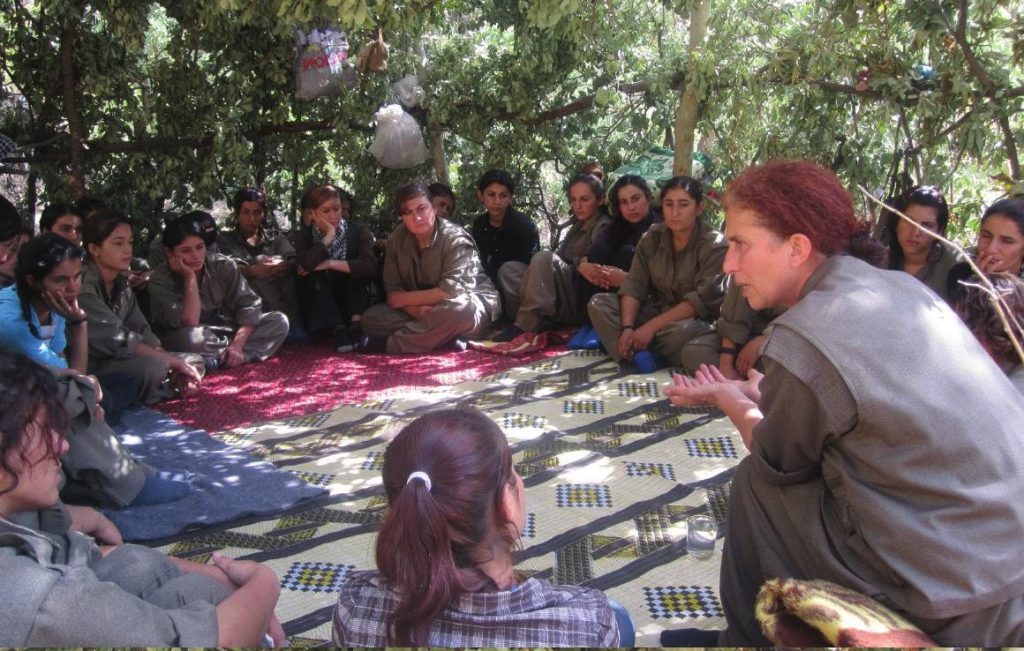
A different education was deemed necessary to replace the ideas that an oppressive colonial system has instilled in the minds of the oppressed Kurdish people. This has taken many forms in the movements. First, education took place in students’ homes, back rooms of private houses, or in parks. Later, prisons and guerrilla camps became important places of education. Finally, from 2000 onward, more and more schools called “academies” were set up in different places to institutionalize the process of education.
The first academy of the party was founded in 1981 in Lebanon’s Beqaa valley, at the time home to several revolutionary organizations. Reportedly the Kurdish militants there stunned fellow fighters from other movements by spending a lot of their time on political and general education. After the death of Agit (Mahsum Korkmaz) in 1986 it was named “Mahsum Korkmaz Academy” and in 1993 it was moved to Syria.
An important method of education developed there were the dialogues, similar to Socratic dialogues. Asking questions helped the individuals to question their upbringing, their beliefs, their national or class background. Most dialogues and discussions in the Academy were recorded, many of them distributed and watched at different places and in different times. Some were transcribed and made it into books that were either circulated internally or published in Turkey, Europe and several Middle Eastern countries and in different languages.
Following his famous adage “What is analyzed here is not the moment but history, not the individual, but society,” Öcalan and his dialogue partners tried to revert the influences of the colonial education system and create free, independently thinking personalities. Later this academy moved to Syria and became even more focused on political education and personality development. Possibilities to engage more deeply with a topic and write on it were created. Many books were conceived there, for instance the three volumes of Sakine Cansız’s My Whole Life Was a Struggle in 1996–97. Specific and exclusive educations for women took place from around 1995 on, and many of the future leading figures of the Kurdish Women’s Movement attended these.
It was in the context of this academy and, in September 1996, during discussions about woman’s freedom, that the famous dialogue later published under the title “Killing the Male is the Principle of Socialism” took place (Sayın 1997, 295–324). Öcalan startled everybody present with his radical statements on masculinity praising the famous Turkish artist Zeki Müren, who had just passed away. Müren had always appeared on stage in women’s clothes. Öcalan described him as having made a revolution against the classical masculinity and family relations in Turkey’s society. “Killing the male” included “killing power, domination, inequality, intolerance and led to killing fascism, dictatorship and despotism.” The dialogue with a Turkish leftist journalist which was taking place over two weeks in front of everybody present at the academy sparked lively discussions immediately — unfortunately, to my knowledge it still has not been fully published in any western language. Nevertheless, the long term impact of the above-mentioned educational discussions is still felt throughout the Freedom Movement.
The Kurdish women’s movement took up the discussion and analyzed the implications of “killing the male” for all areas of life. This example shows how a topic that was already “in the air” and being discussed at the academy was condensed to a catchy phrase, only to be later expanded for decades, thus increasing the depth of the initial analysis.
Another important aspect of the academy is their breadth of the impact. Discussions were transcribed, edited and published in various media (newspapers, books, tape cassettes, videos), transcending the physical limits of the academy as a location. The discussions and their consequences were carried to many places where people once present at the academy went or wherever those media were read, listened to or watched: family homes, guerrilla camps, prison cells, and associations in all parts of Kurdistan and abroad. This was intentional. It is important to emphasize that the aim of the struggle was explicitly to change the own society. Öcalan stated that only 10 percent of the effort was aimed at the enemy, while 90 percent at the Kurdish society and militants themselves to change. To remove the effects of colonialism in society continues to be the bigger task, since the initial aim of highlighting the Kurdish issue and giving the Kurdish people an authentic political voice has been successfully accomplished.
Free Thinking, Free Will
The emphasis on independently thinking personalities was amplified when in the 1990s the idea of women’s freedom gained more prominence in the movement. “Free thinking, free will” became the second of the five principles of the “woman’s liberation ideology,” proclaimed in 1998. Free thinking and free will means a break with patriarchy, the ability to formulate one’s own ideas and goals, independently from men. We can easily see the parallels with the need for an education independent of the colonial state education institutions. Since this can only be achieved collectively, the third and fourth principle, “being organized” and “consciousness of struggle,” point to the fundamental method for implementing those ideas and goals. While such principles were formulated at the Mahsum Korkmaz Academy, the system of academies, schools and courses elsewhere made sure that they did not remain mere words on paper, but were discussed, understood and developed over the years. This network of educational activities were taking place in prisons as well as military camps in the free mountains of Kurdistan, but also in family homes as well as associations.
After the paradigm shift in the movement became visible in the 2000s with the dissolution of the PKK in 2002 and the establishment of KCK as a less hierarchical and more flexible structure, there were efforts to found academies on topics as politics, language, culture, communalism and ecology in towns and cities in Bakurê Kurdistan (the region under Turkey’s rule). These initiatives were met with fierce repression by the Turkish state, and the educators were often among the first thrown into jail in the string of police operations that rocked North Kurdistan and Turkey from December 2009 on.
Elsewhere, education in the tradition of the Kurdistan Freedom Movement has been more successful. Jineolojî as a revolutionary research practice by and for women has developed into a global network. Originating in Rojava, specifically the region of the Democratic Autonomous Administration of North and East Syria, several academies outside of the state’s education system have been established, from military academies of the Syrian Democratic Forces that were crucial in the struggle against ISIS, to the Academy of Jineolojî and its several research centers like the Andrea Wolf Institute.
Lessons from this tradition
This short and incomplete outline of the movement’s tradition of education and the role of academies is meant to highlight a couple of crucial lessons to draw from this experience:
Continuity is important as it makes it possible to develop new concepts over the years. Knowledge and experience can accumulate and grow through this.
There needs to be an intensive exchange between the core activists, the “professionals of hope,” as Subcomandante Marcos called them, and society. In a way, the academy must be open to engage with society.
The new direction that the movement took since the early 2000s with the increased focus on women’s freedom, democracy, ecology, and self-defense inspired the foundation of numerous new or renewed academies, big and small, in Kurdistan and the diaspora. They work on topics as different as health or local history, Jineolojî, municipalism, art or journalism.
The openness of the paradigm of the movement makes it possible for these academies to relate to a wide variety of tradition outside of classic academies and universities, like religious schools or the education traditions of tribal societies, shamans, or the secret knowledge of women.
While utopias are crucial, a certain direction is needed to get closer to them. In a reflection on the his-tory of the movement he created, Öcalan wrote in 2011: “Without a doubt, one cannot proceed without dreams; but one cannot achieve a free and righteous life with dreams and hope alone. Establishing sufficient concepts and cadres was the primary activity during the first decade” (Öcalan 2012, 327)
The Sociology of Freedom
Throughout the decades, the Kurdistan Freedom Movement has always been an anti-colonial movement at heart. What has changed, however, is the way colonialism, colonization or “being a colony” is perceived. An important point had always been on the immaterial aspects of Kurdistan’s status as a colony, especially the ban of the Kurdish language in several parts of Kurdistan and the restrictions placed on it in others. In North Kurdistan (the part occupied by Turkey) the language had not only been banned but the mere existence of the language (and therefore the Kurdish people) had been denied. Turks and Kurds had been taught absurd theories on what this other language was and how the Kurds were actually not Kurds originally. In short, not only the land, but the very minds of people had been colonized. A Kurdish poet and human rights activist explained it to me in the mid-90s in these terms: “The worst thing is that I have started to dream in Turkish. Even my dreams have been colonized.”
This kind of colonization is by now widely analyzed and a lot of literature on it exists. Seminal anti-colonial theories have been widely read in the formative years of the Kurdistan Freedom Movement: Frantz Fanon’s Black Skin, White Masks (1952) which analyses the mentality of the colonized people and Paolo Freire’s Pedagogy of the Oppressed (1968) which shows ways out of it — through education. Building on these core readings, the movement created its own body of texts and methods.
While in the 1970’s the analysis of colonialism centered mainly around the status of Kurdistan — colonized, divided between four nation states, a people and their language denied and at the brink of self-denial — , this changed in the early 1990s. The party had evolved into a broad popular movement with many relatively young women joining the ranks. More and more people from different walks of life were reached and concrete societal problems played a bigger role, because they manifested also in the organization. In this situation, women’s freedom or rather the lack thereof was analyzed as the central problem of Kurdish society. The oppression of women was conceptualized in similar terms as the colonization of Kurdistan, leading to the idea of women as the colonized sex. Slogans like “Without free women there can be no free Kurdistan” express this shift in understanding of colonialism.
To what extent are we all colonized?
In his prison writings, Öcalan widened the scope of his anti-colonial analyses yet again. It is not only colonized and oppressed people or women — as the first colony — whose minds are colonized. He ex-amines the ideological structures that have legitimized all systems of oppression in human history or at least the history of state civilization and how these structures have always served those in power.
In The Roots of Civilisation, (written in 2001, English edition 2007), he makes the argument that 5000 years ago when the first states in human history, the Sumerian city state, were founded, they needed a strong immaterial basis. The construction of states based on slavery could not have been achieved simply through violence. There must have been an economic attraction and — even more important — attractive narratives that legitimized the new order with hierarchies unknown hitherto: on the one end there were god-kings and priests that communicated exclusively with the gods and goddesses, on the other end there were women and men enslaved through debt or wars. The role of the priests was not only the organization of the economy, which was centered around the grand temples, the ziggurats, but the creation of a mythology that justified the service of the many for the few. A striking example is a creation myth in which the first human is not formed from clay or soil, but from the excrement of the gods. The reason for the creation of these lower beings is simply that the gods are tired of serving each other, so they create humans with the explicit purpose to serve the higher beings, the gods. Ever since, similar mythologies and religious tales have convinced humans that there are prefigured hierar-chies that cannot be questioned.
The function of the ideologues in later (statist) societies has been similar. The dominant form of knowledge production or knowledge re production served to legitimize and perpetuate the existing structures of power. Ideas that were revolutionary in their time — for instance Jesus of Nazareth preaching the equality of humans as brothers and sisters in a remote province of the Roman Empire (the largest slave-owner empire the world has ever seen) — were later integrated into state ideologies and eventually used to legitimize domination.
Today nationalism has taken the form of a secular religion and is shaping our thinking in manifold ways. While the belief in god-kings and the divine right to hold slaves in today’s world is somewhat on the back-foot, the currently dominant regime of truth in capitalist modernity, scientific thought, is rooted in the same hierarchical tradition. The official institutions of education — schools, universities and armies — are tightly integrated with the existing power monopolies: nation states and super-wealthy companies, dynasties and increasingly rich individuals. Since the educational institutions shape the thinking of almost every individual that passes through them, it is hard to expect a meaningful and effective, radical criticism of these power monopolies.
Öcalan criticizes the current scientism the belief that only science can produce truth as a key connection to the stability of power monopolies. Positivism, the approach that only observable facts matter, has become a mythology of its own, posing major problems to the social sciences. Many forms of knowledge that matter to societies are deemed irrelevant or plain “wrong,” simply because they are outside of the scope of what “modern science” considers worthy. Furthermore, ethical and political questions that are not limited to examining what the existing structures are but ask how society should be are deemed irrelevant, thus excluding creative, utopian and revolutionary thinking about a future society.
On the other hand, the confrontation with a global culture industry and a global system of capitalist commodity production endangers traditional value systems and threatens to destroy what keeps society together — a phenomenon that Öcalan has called “societycide” in his writing (2009, English 2020). The idea of democratic civilization as a continually existing structure that remains more fundamental, more universal, and more rooted and natural than statist civilization and ultimately cannot be erased without killing society altogether offers a strong perspective to overcome the differences between the countless struggles against capitalist modernity.
The battle against the knowledge structures of capitalist modernity is not without its own problems. When there are new ideas born out of an intense practical political and social struggle, the ideas may not find enough space to breathe. People may not find the time to stop and think, to discuss and learn sufficiently. There is always something to do for the activists, new challenges and struggles await. Numerous areas of interest may be brushed aside because “now there is not the time for it” or “there are more important topics to work on.” Also, in time, the activists themselves may change faster and they may not be able to transmit their knowledge and experience to those who come after them. The accumulated knowledge and experience of a movement may be thus lost.
All these points underline the importance of creating institutions where an exchange of knowledge can take place, where different trains of thought can be pursued. Just as the gains of democratic modernity must be defended, its research and conceptualization has to be sustained with cultural and educational institutions. Considering all this, how can we build these institutions, our own academies?
The sparks of an intellectual revolution
The new, non-state paradigm of the Kurdistan Freedom Movement offers new ways to look at the problems humanity is facing, but also new ways of tackling them. To think the struggle for women’s freedom, class struggles, ecological struggles, and cultural struggles together, as aspects of the fundamental contradiction between democratic civilization and state civilization — not only in the form of an alliance but as inherently connected — can help develop new connections across all kinds of borders and boundaries. All these struggles are rooted in local realities, rather than aligned rigidly to an ideology, party line or strategy imposed from outside, and that is what will make the new structures of resistance more flexible, authentic and credible.
In the past there have been several forms of institutions: political party schools or even free universities that sprang from movements. But the examples from real-socialist states show how even schools dedicated to radical and revolutionary thought can suffer from dogmatism and too much proximity to power. On the other extreme, some people reject institutions and schools altogether. They argue that institutionalized thought will inevitably become static, dogmatic and create new hierarchies. Therefore, they prefer free floating thinking and learning on their own, or only in small groups.
An academy that strives for meaningful social change or even an intellectual revolution must avoid both extremes. It should be independent from the power monopolies and close to society, while at the same time organized enough to provide political vision and tools to address all the difficult tasks lying ahead. An academy would be based on a deep critique of academic institutions, the historical foundations they rest on, the power structures they are embedded in, and their exclusion of numerous traditions of thought and numerous knowledge systems. If universities tend to be separated from the society they ostensibly should serve, a revolutionary academy must do the opposite: include different traditions of thought and build bridges between them; unearth and integrate various knowledge systems; and be tightly connected to the society.
If such a radical academy claims to contribute to an intellectual revolution, the stakes naturally become much higher: it needs to be several steps ahead and must prefigure the kind of intellectual work that it wants to see happening in the revolution. Academies in this sense should be places where all the different ideas and traditions of thought can meet and be explored, with the aim of seriously engaging with the task of not only criticizing negative developments but forming real alternatives in the sphere of ideas. This can only happen in a collective process, involving living together, working together, and struggling together, the heart of which is the space of the academies.
By bringing together potentially everybody who is interested in changing the world for the better, academies rooted in the principles and traditions of the Kurdistan Freedom Movement can become the crystallization and departure points for any revolutionary change.
References
Cansız, Sakine. 2018. Sara: My Whole Life Was a Struggle. London: Pluto Press.
Cansız, Sakine. 2019. Sara: Prison Memoir of a Kurdish Revolutionary. London: Pluto Press.
Cansız, Sakine. 2015. Hep kavgaydı yaşamım, III. Cilt (My Whole Life Was a Struggle, Volume III). Mezopotamien.
Öcalan, Abdullah. 2007. Prison Writings Vol. 1: The Roots of Civilisation. London: Pluto Press.
Öcalan, Abdullah. 2020. The Sociology of Freedom: Manifesto of the Democratic Civilization, Volume III. PM Press.
Öcalan, Abdullah. 2012. Demokratik Uygarlık Manifestosu, Beşinci Kitap (Manifesto of the Democratic Civilization, Volume V): Kürt Sorunu ve Demokratik Ulus Çözümü (The Kurdish Question and the Democratic Nation Solution). Wêşanên Serxwebûn (English translation forthcoming)
Sayın, Mahir. 1997. Erkeği Öldürmek: Abdullah Öcalan Ne Diyor? (Killing the Male: What is Abdullah Öcalan saying?). Basel: Toprak Yayınevi.