by Asli Filiz
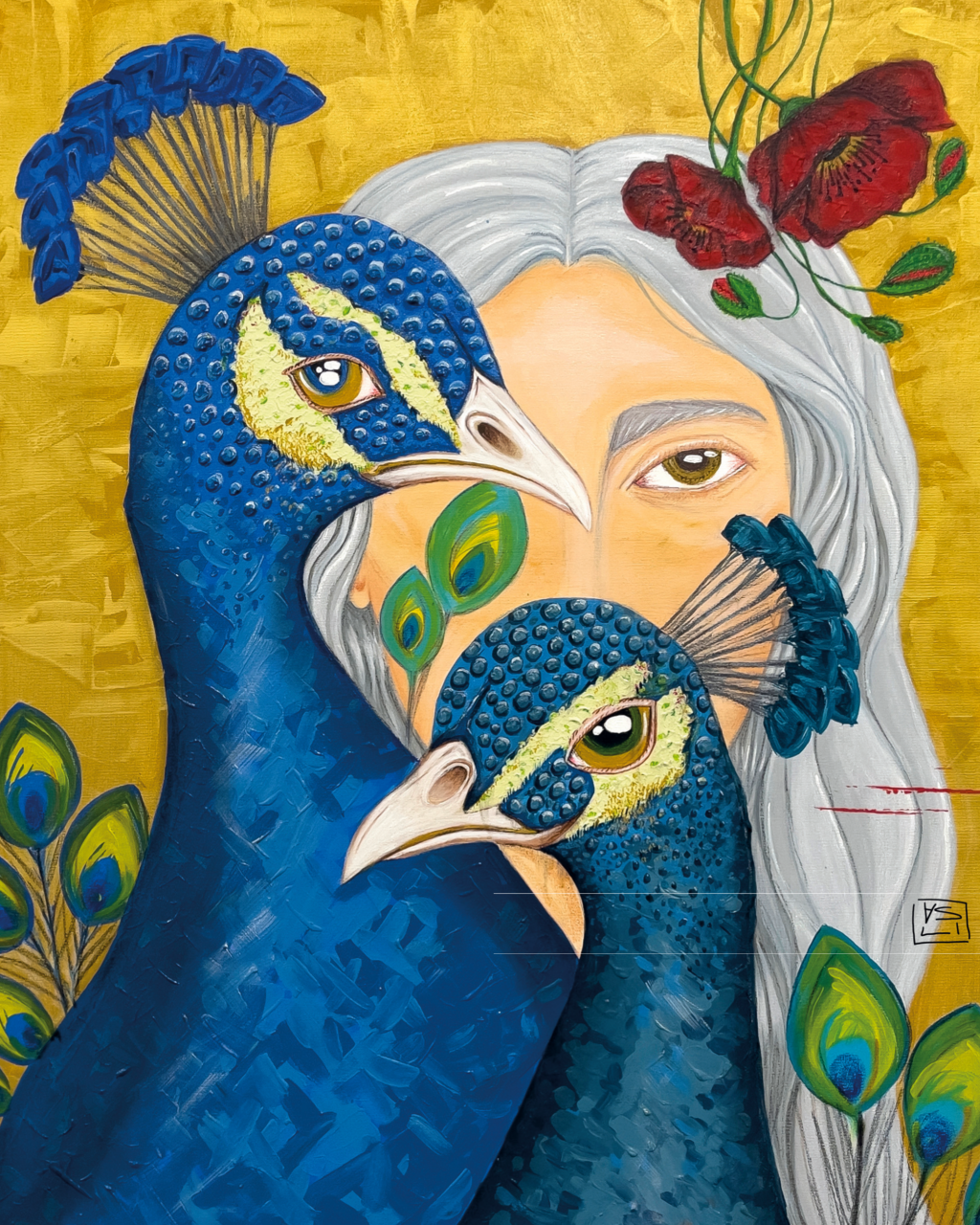
This work is an intimate and deeply charged artistic testimony a visual space where I confront the historical traumas, cultural endurance, and resilient spirit of Êzîdî women.
I did not create this piece merely to represent something, but to carry something: a vessel of collective memory, holding both our scars and our sacred strength.
At its center stands a white-haired, weary-eyed woman. She is not a portrait of anyone I personally know, but the embodiment of many women whose stories live within me. Her hair is white not from age but trauma, symbolizing the marks of grief, abrupt loss, and a forced maturity that arrived far too early for the Êzîdî woman.
She carries not only her own pain, but the layered suffering and perseverance of Êzîdî women across generations. In her gaze, I sought a quiet defiance, a look that balances exhaustion with unyielding strength.
Showing only one of the woman’s eyes was a deliberate choice. I wanted to reflect the fractured nature of memory, how trauma shapes what we can bear to see. The visible eye looks outward, witnessing the world as it is. The hidden eye turns inward, holding memories that remain unspoken, truths buried beneath silence, and stories the world has not yet been willing to hear. That absence speaks as loudly as what is shown.
The red marks in her hair are not decorative; they are wounds. They speak of violence etched into both the physical and cultural fabric of our lives rupture held alongside resilience. Interwoven with these marks are poppy flowers. In Êzîdî culture, the poppy symbolizes mourning, yet for me it also embodies resistance. Its paradox fragile yet enduring, soft yet unyielding mirrors the strength with which Êzîdî women carry their pain.
Beside her, I painted two peacocks, drawn from the sacred tradition of Melek Taûs1. For me, they are more than aesthetic forms; they are guardians and symbols of divine protection, spiritual resilience, and the communal solidarity that has allowed my people to endure unimaginable trials. Their presence weaves faith into the narrative, reminding us that the Êzîdî story of survival is inseparable from belief.
The golden background is my act of sanctification. I did not want this to be a portrait of despair alone. Gold transforms her into something sacred an icon of memory, rever- ence, and cultural endurance. By surrounding her in gold, I insist that our grief must not be hidden or diminished. It deserves to be honored. It deserves a place in history.
Ultimately, I created this piece to expand the visual archive of the Êzîdî experience. My aim was to create both a memorial and a mirror image: a space where viewers can witness our sorrow but also recognize the indomitable strength that defines Êzîdî womanhood. This piece is a visual elegy, but also an act of cultural resistance a reclaiming of narrative space in a world that too often ignores or erases our stories. For me, art is inseparable from memory and faith. These forces intertwine as pathways toward healing, identity, and survival.
Through this work, I hope to preserve fragments of our collective story, otherwise threatened by silence.
Trauma, I believe, is not only a wound but also a generative force: shaping community, fortifying identity, and igniting new narratives. My hope is that Silent Scream stands as both a witness and a voice insisting that the experiences of Êzîdî women be seen, remembered, and carried forward.
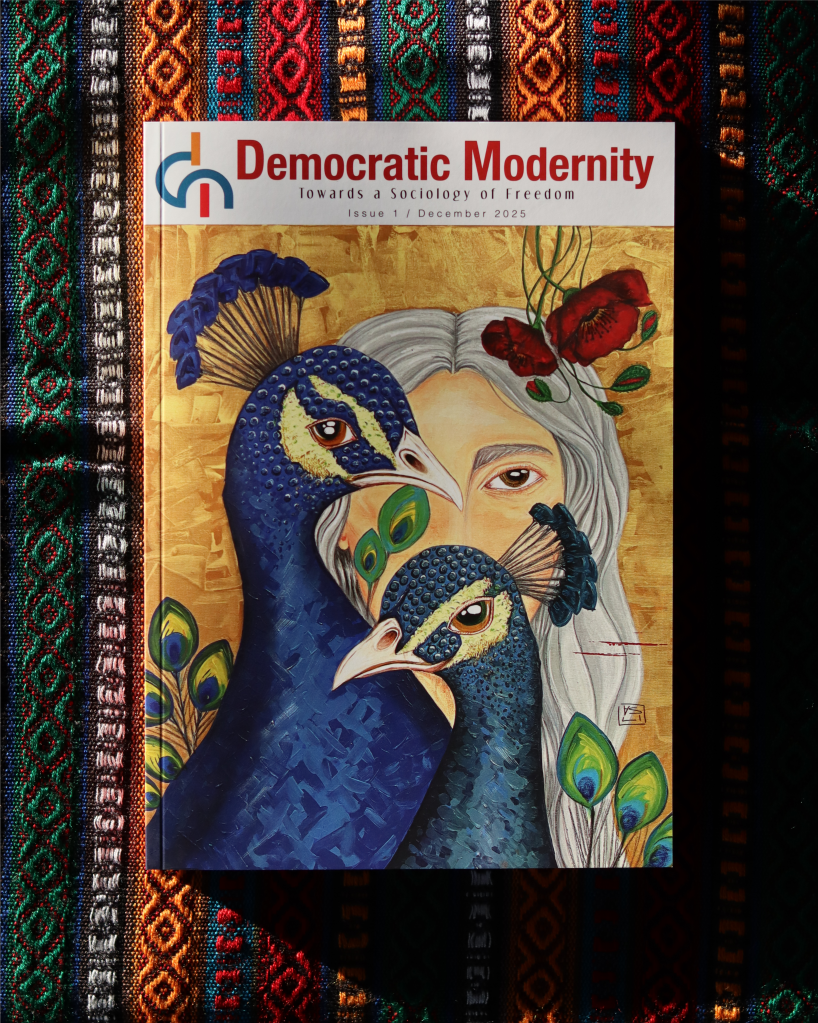
I am grateful that this piece of mine serves as the face of the first issue of our journal, Democratic Modernity. The references in the editor’s note to a “larger reality” and “developing a sociology of freedom” remind us of the effort to make visible what dominant histories have concealed. My work aligns precisely with this purpose; it centers on a sidelined narrative and emphasizes that memory itself is a form of resistance.
Thus, my piece on the cover not only reflects its spirit but also the aesthetic quality of the journal.
I hope that this will be received as a small yet meaningful contribution to honoring silenced voices and expanding the realm of freedom, truth, and human remembrance.
Notes
- Melek Taûs, the Peacock Angel, is one of the central figures of Êzîdî creation stories. Before the creation of this world, God created seven Divine Beings, of whom the Peacock Angel was appointed as the leader. ↩︎