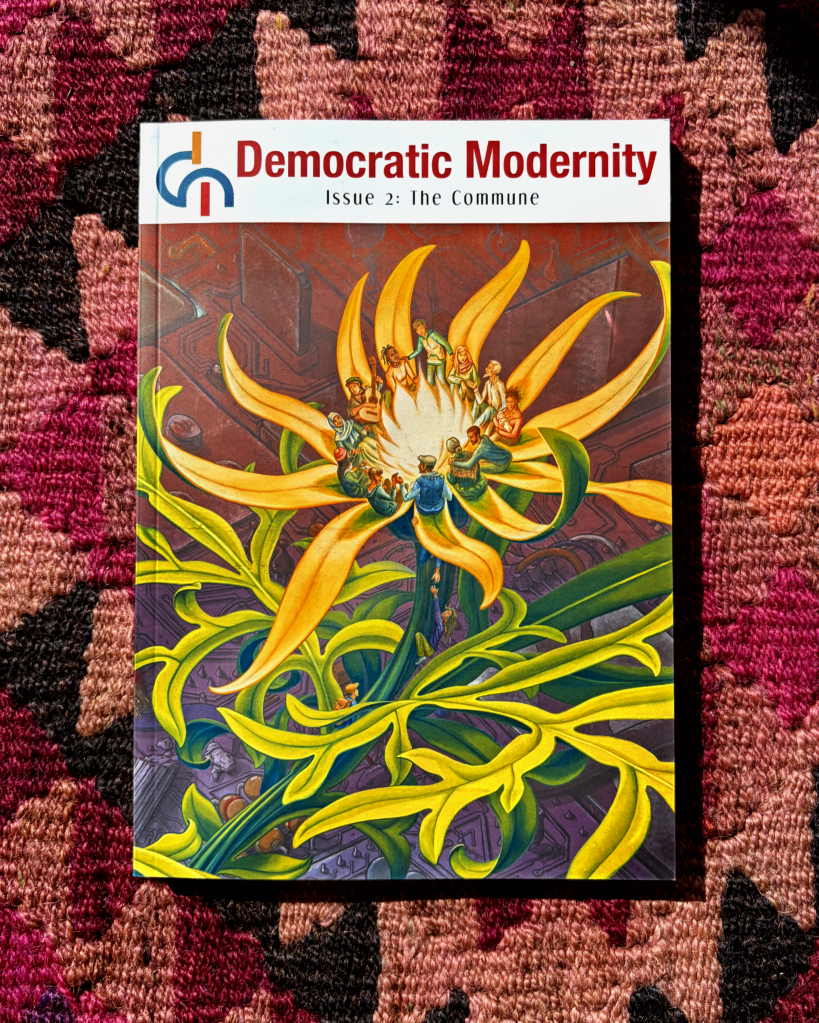
By Nik Matheou and the Editorial Collective
The journal is a publication of the Academy of Social Science, an international collective of scholars, activists, and artists from global intellectual and revolutionary traditions, with a perspective rooted in the thought of the Kurdistan Freedom Movement (KFM) and its leading thinker, Abdullah Öcalan. Our first issue explored some essential elements in this perspective, and now, with our first dedicated theme, we turn to perhaps the most fundamental question: the commune against the state.
The opposition between the commune and the state is central to the new social and political paradigm for liberation developed by Öcalan and the KFM since the ’90s, and has been recently recentered in the Manifesto for a Democratic Communal Society (forthcoming, 2027). Written by Öcalan and other movement activists imprisoned with him on the prison island of İmralı, this most recent manifesto to escape incarceration as a flame of hope encapsulates the triple nature of the commune: cornerstone of human sociality across history, vehicle of liberation in the here and now, and foundation of a free life in a truly democratic modernity. Öcalan and his friends form nothing less than the İmralı Philosophy Commune, developing their collective life in a consciously created space of deeply interwoven intellectual, emotional, and practical relationships. Their theoretical work is an inseparable part of their communality; a conscious reflection on the nature of their own sociality while imprisoned, and so also that of humanity under state civilization, as well as the potential routes to its overcoming. Only by consciously living as a commune could Öcalan and his friends theorize the form’s centrality to all social relations, and only in their collective struggle against some of the most intensive incarceration found anywhere in the contemporary world could they practically understand its strength to resist the most naked impositions of state power.
The Commune Through the State?
As with many aspects of the decades-long Kurdish liberation struggle, the İmralı Commune resonates with theories and enriches practices with deep roots. From 1973, Öcalan and his closest friends developed their theory and practice inseparably from sharing their everyday lives communally—their earliest political education and organizing happened in intimate meetings in houses. Their politics developed in these lived spaces, and their weaving into the social fabric of communities. The approach proved itself in practice; when the movement emerged into the open in ’78 with the founding of the Kurdistan Workers Party (PKK), it already had deep roots in the communal life of Kurds and Kurdistanis. Likewise, when the Turkish army launched a coup in 1980 and imprisoned activists en masse, they formed communes to resist the most extreme carceral conditions and torture. These foundations have only become more robust as the struggle has deepened.
Still, while the movement’s practice focused at the most intimate communal levels from the start, theoretically the party program of ’78 speaks of a struggle to establish a democratic, socialist nation-state of Kurdistan. If successful on these terms, the movement most likely would have followed the same path as other Marxist-Leninist parties, using state power to transform private into public property, and implementing development policies to industrialize and create the material basis for “full” communism. Certainly this was the assumed program for countless contemporary anti-colonial revolutionaries, and appeared eminently logical: the most seemingly successful revolutions had all centered state power and control of the “commanding heights of the economy” as the essential preconditions for social revolution.
From Russia to China and beyond, successful revolutions had been effected through consciously created communal spaces acting as counterpower to the reactionary, capitalist, and colonial regimes they sought to overthrow. These spontaneous bottom-up organizations should have formed the stem cells of the new socialist society. In each case, however, contradictions emerged between the Marxist-Leninist vanguard as the embryo of a party-state, and the communal counterpower that enabled the overthrow of the old state system, until those were eventually neutered. This consistent pattern underlines the fundamental contradiction between means and ends in classic Marxist-Leninist revolutions; a popular struggle based on organized communal counterpower, and a state-centric method of building a new socialist society.
This contradiction is clearest in the attempts of post-revolutionary party-states to mandate communal and cooperative organization from the top down. Proponents of state-led transitions shared the same high modernist worldview as Western capitalists: a self-confident, almost religious faith in linear progress, rational design, scientific agriculture, and industrial-style efficiency. As anarchist political scientist James C. Scott outlined in his 1999 classic Seeing Like a State, high modernist “progress” was achieved by and through an activist state willing to use authoritarian and coercive methods in the name of “development”. These methods aimed at making human and non-human natures legible: simplified and rationalized realities on the ground that can be effectively abstracted into governmental records and “efficiently” administered from a distant center. By making society-in-nature legible, both were rendered weak and prostrate before state power.
In this high modernist worldview, even if socialist values like mutual aid and shared labor were found in traditional settings, and these in turn provided the basis for organized counterpower in the revolutionary struggle, they were subsequently dismissed for their apparent “backwardness.” Across the regions ruled by party-states in the twentieth century, organic and more-or-less communal modes of life existed on the basis of generations of accumulated ecological knowledge and adaptation, and successfully ensured both subsistence and dignity. These were highly complex social practices proven across generations, but from the point of view of the central state, this largely non-literate, highly ecological logic to everyday life appeared simply as chaos and irrationality.
From Central Asia to Tanzania, the result of these top-down projects was widespread ecological damage, including rapid soil exhaustion, destruction of water basins, and much more besides. Socially, too, these efforts revealed what Öcalan has referred to as a “social engineering mentality”. Notwithstanding early experiments in the USSR, party-state officials from East Africa to East Asia imposed the normative structure of the nuclear family—as Öcalan notes in the present issue, they completed the transformation of the family into the smallest unit of the state. Avowed socialists promoted explicitly patriarchal agendas, solely valorizing women’s domestic roles as wives and mothers. Marx himself in his late writings suggested that the Russian peasant commune might form the basis for a transition to socialism without passage through capitalism, but these Marxists destroyed such communities, ironically with the intention of creating ideal communes. Instead they created the ideal conditions for the full imposition of capitalist modernity with the fall of state socialism.
Across the twentieth century, then, various movements sought to use the state to build a genuinely communal socialism. These were genuine schemes for liberation, carried out largely in good faith by those who truly believed in their potential. As a socialist and anti-colonial movement, these examples were known, discussed, and debated by the Kurdistan freedom movement in its formative years. Yet, by the ’90s, all these revolutions had failed to varying degrees.
New Perspective, New Paradigm, New Politics
The manifest failure of twentieth-century state socialism led Öcalan and the KFM to fundamentally critique the state as such. Seen from the perspective of revolutionary struggle against reactionary, capitalist and colonial states, the contradiction appears to be between communality and those specific kinds of state system. But seen in the aftermath of wide-ranging, genuine, and tragic attempts by strong movements to build communal socialism, there is self-evidently an insurmountable contradiction between the commune and the state, whatever form the latter might take.
This shift in perspective necessitated a new analysis of society—the beginnings of the new paradigm eventually termed the sociology of freedom. Marxist-Leninist practice had been based on the theoretical centrality of class, as in the words of the Communist Manifesto, “the whole of history to this point has been the history of class struggles.” When first published in 1848 this statement was unqualified, but, importantly, Engels later added a moderating footnote: this only applies to all written history, since human pre-history appeared to have been characterized by common ownership of land, with village communities constituting “the primitive form of society everywhere from India to Ireland.”
Named “primitive communism”, Engels essentially reframed in Marxist terms the work of early anthropologists to present a scheme of progressive stages from early stateless societies, through to state civilization. Framing humanity’s earliest social organization as communist was intended to demonstrate that “human nature” isn’t inherently greedy, competitive, or hierarchical. Indeed, the “ascent” to civilization appeared closer to the historical equivalent of Dante’s descent through the levels of the Inferno, each stage defined by a loss of communal capacity, especially manifest in the increasing degradation of the position of women. Yet at the same time Engels’ analysis was overdetermined by an assumed logic of material necessity: “primitive communism” could not provide the basis for universal communal living, since low levels of technology left humans isolated in small groups, and at the “mercy” of an externalized Nature.
So “primitive communism” proved that humans could live communally, but they only would do so on a global scale if they proceeded through the necessary stages of domination and exploitation in which this aboriginal communality was largely lost. With each stage the mechanisms of exploitation would develop new productive forces necessary for eventual communism, and this required class divisions, state systems, and the “world historic defeat of the female sex.” Even so, Engels argued, this would still lead inexorably to the victory of the proletariat, who would replace the state with the kind of “non-state” glimpsed in the Paris Commune, overseeing its own withering away in favor of truly “commune-ist” administration of everyday life.
There were, of course, dissenting voices throughout the twentieth century—notably Murray Bookchin, a major influence on Öcalan and the KFM from the early 2000s. In his 1969 pamphlet “Listen, Marxist!”, Bookchin points out the fundamental flaw in the revolutionary paradigm resulting from traditional Marxism: Marxist-Leninists conceived of socialist revolution identically to previous revolutions where one ruling class replaced another, despite the fact that the communist revolution was supposed to be about the total abolition of class as such. Instead, Bookchin argues, “a social revolution can only emerge from the decomposition of the traditional classes”, rather than their affirmation in a supposed “dictatorship of the proletariat”.
Engaging with dissenting and unorthodox traditions of Marxism and libertarian socialism, including Bookchin, world-systems analysis, and Marxist feminists such as Maria Mies, Öcalan and the KFM concluded that class cannot be centered in the struggle for a free life: class co-develops with the institutions of state civilization, they are mutually reinforcing, and any liberatory politics premised on affirming a class position is doomed to create yet another regime of accumulation within this totality. Only by looking beyond class as the vehicle of liberation could a paradigm be developed that likewise looks beyond the limits of state civilization and capitalist modernity. But whereas Bookchin emphasized post-class formations emerging within the classes of capitalist modernity, Öcalan looked back to pre-state formations to see a continuity of communality throughout subsequent history.
This is not about romanticizing and recreating some past utopia. What was “lost” was less an ideal human society than one in which the commune form predominated, and was immediately social in its totality—that is, it integrated political and economic functions while constituting a validating cultural, moral, and ethical universe. These were not alienated “spheres” of politics, economics, and culture, or public versus private domains as in class society. To riff from David Graeber and David Wengrow’s 2020 monograph “The Dawn of Everything”, the question for those struggling for a free life is less the class-centric “how did we become unequal”, than “how did we get stuck” in a fixed social order where these integrated social-communal spheres are steadily separated?
Here historical materialism does have the crucial answer: systemic domination through the exploitation of labor. By reproducing domination through the productive activity by which associated humans feed, clothe, and house themselves, those people are steadily subordinated into a fixed role. But this systemic domination did not begin with class as such, nor did it erase the necessarily communal aspects of our sociality. As Engels noted, but Öcalan, the KFM, and more specifically the Kurdish Women’s Movement have placed at the center of the new paradigm, the first human category to be systematically subordinated for their productive labor were women: not as a biological fact, but as a gendered construct to maintain a fixed social order. Stateless societies, and especially those attested archaeologically and in mythological echo prior to the emergence of state civilization, tend to be matricentric: they placed the life-making potential of female-sexed persons at the center of their worldview and symbolic universe, and this was seemingly reflected practically in the centrality of these values and symbols in communal life. Under state civilization, conversely, this life-making potential was reduced to a relationship of exploitation and enclosed in a “private” domain within the household, while men would produce for a surplus appropriated and managed by the propertied class in the increasingly male-gendered “public” domain.
Although hegemonic common sense presumes that the “public” political and economic domain is prior to the “private” world of social reproduction, logically the precedence is the reverse: before any surplus can be appropriated, humans must be birthed, raised, fed, clothed, housed, and acculturated into a moral and ethical universe. All these predicates are aspects of human sociality that continue to take place through necessarily communal relations, what David Graeber has termed “everyday communism”, in that they are fundamentally premised on the principle “from each according to ability, to each according to need”. If communism is a necessary predicate for human sociality in the abstract, the social units in which the reproduction of life takes place are best described as communes. In most cases these communes are unconscious, but in some they appear more conscious, providing a glimpse of the commune as a vehicle of liberation beyond state civilization.
How human communes became “stuck” in the role of reproducing the basis for state civilization remains a central question. Stateless societies across history tend to have moral and ethical universes that function as an “imaginary counterpower”, and are embodied in practices explicitly intended to avoid the emergence of fixed hierarchy. Given that humanity has been biologically modern for at least 100,000 years, and that primary state formations—those that emerge where no state systems have existed previously—are extremely rare historically, humans have a long track record of avoiding the emergence of systemic domination and exploitation.
Once primary state formation has taken place, however, systemic domination and exploitation becomes a stubborn social cancer, especially in the form of patriarchy. Öcalan has drawn attention to the echoes of patriarchy’s pristine emergence in West Asian, North African, and Eastern Mediterranean mythologies, where matricentric figures of ritual observance are violently displaced by patriarchal figures of control and destruction. These mythologies correlate with the chronology for the development of systemic exploitation and true private property. Perhaps the most famous is, indeed, the Eden story, which might even be read as an inversion of the true Fall: not of Man, but of Woman, making the communal society in which she had been central weak and prostrate in the face of the emerging state.
Across the history of the last five thousand years there is a constancy to patriarchal domination once developed, even as societies change drastically in their wider political and economic regime. So, as much as there is a continuity of the commune as the cornerstone of human sociality, there is also a continuity of patriarchal cancer cells enabling the transformation of delimited household- and small-community based communes into those regimes’ foundations. Comprehending these intertwined dynamics requires holding both truths in mind: the necessary communality for human existence can be transformed into the basis for class domination, but it also pre-exists both class and state, and exists in absolute tension with both.
In short, therefore, Öcalan and the KFM’s perspective demands a refoundation of historical materialism with the commune as the central operative concept, and patriarchy as the foundational relation of exploitation and domination. This in turn implies a refoundation of revolutionary politics as genuinely “commune-ist”, maintaining an invariant focus on identifying existing communes and nurturing them into a conscious political form. In these terms, “class struggle” properly understood means a fight against the very imposition of class relations, and especially their integrated manifestation with patriarchy, through the re-integration and expansion of already existing elements of a communal free life. The making-conscious and linking of communes into a counterpower is not mere preparation “for” the revolution, it is the revolution.
The Present Issue
All these issues are reflected in the articles you can find in this issue, but they are by no means exhaustive. These openings might be guided by key ideas from Öcalan and the KFM, but the work of seeing the world anew is for all of us.
As Öcalan argues in his contribution, the commune is not a new invention or a simple alternative model of governance, but rather humanity’s oldest, most natural form of organization and the embodiment of society’s will to recreate itself. By contrast, the state and the nuclear family function as complementary mechanisms that erode this communal spirit, severing the individual from society to strengthen the state and the market. This historical tension between state-centric failure and communal persistence is explored by Mathijs van de Sande and Gaard Kets, who trace the Paris Commune’s enduring legacy as a reinventable cry for radical democracy.
Mustafa Karasu expands on this theme by presenting the Kurdish Freedom Movement as a historic counterpower, offering communal confederalism as a practical, hopeful vision against the rampant individualism and perpetual crises of capitalist modernity. As he underlines, because the state’s historical emergence relied on the subjugation of women, rebuilding democratic society requires that women act not merely as participants, but as a guiding and constituting force within the commune. Without women’s freedom, there can be no freedom for the commune. Mechthild Exo applies this principle by challenging traditional, patriarchal models of conflict resolution, arguing that true peace, rather than statist “pacification”, requires women’s leadership and visionary grassroots democracy.
Similar themes emerge at the level of the household in Salima Tasdemir’s review of testimonies of Kurdish women navigating state violence and displacement, showing how reclaiming authorship of their complex histories forges a powerful archive of agency and liberation. In his review of the same collection Patrick Huff highlights this intersection, exploring how the narratives demonstrate the transformative potential of a decolonial and communally-minded feminism against both patriarchal violence and colonial dispossession. This same point emerges from Targol Mesbah’s contribution, where the weaving together of ancestral cuisines and modern mutual aid is seen to cultivate resilient webs of abundance in the face of global capitalism’s war on life. Likewise, Shahrzad Arshadi illustrates this cultural self-defense, exploring oral history and documentary theater as vital acts of resistance against historical erasure and state torture, using art to overcome individualism and build a collective free life.
Turning to the commune’s macro-revolutionary potential, Bengi Akbulut explores the commune as a transformative economic form that democratically reunites production and reproduction, offering a practical path towards a democratic modernity. Finally, in connecting the Kurdish Freedom Movement to Latin American Indigenous struggles, Ana Paula Morel envisions reclaiming the commons and building democratic, living territories against the extractivist violence of the Capital-Anthropocene. This contemporary struggle for freedom from domination and exploitation is further elucidated by the Munduruku Wakoborũn, whose ancient ties to their land are threatened by the Brazilian state and capital. Their resistance is an example of a communal response to the problems caused by state civilization.
These varied perspectives show that the commune is not nostalgia for the past, or a utopian project to be created from nothing, but the very stuff of our shared humanity. It forms the basis both for social life in general, and the potential for society to re-appropriate its capacity to govern by and for itself. The richness of the topic cannot be encompassed in one issue, but we are proud to present you with our first steps, as we hope to walk together with you all under a banner of liberation with those immortal words, “the Commune lives!”