By Benedetta Argentieri
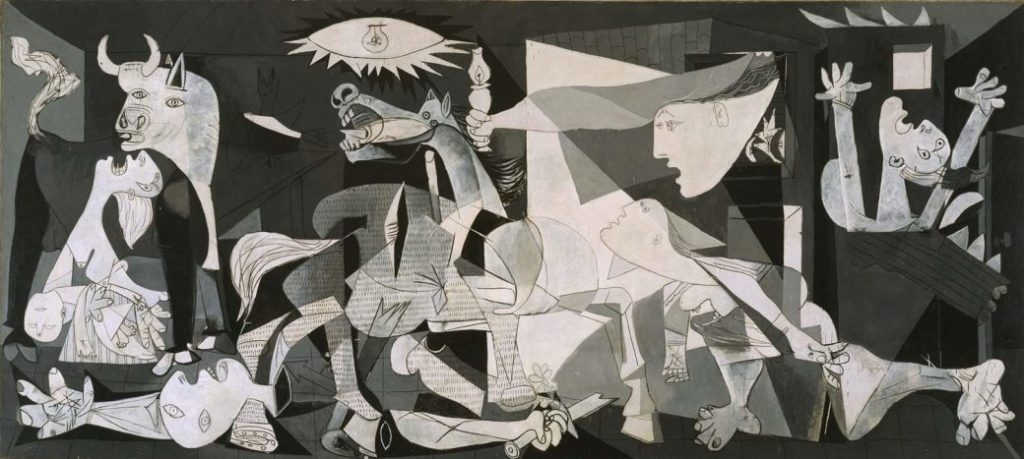
On Monday morning, April 26, 1937, in the small Basque town of Guernica, women and children — the only inhabitants left since all the men were fighting in the Spanish Civil War — were going to the food market in the main square. At the same time, Nazi Germany’s aircraft started bombing the defenseless civilians and completely leveled the town. The French artist and photographer Dora Maar took the pictures that shocked the world. The news deeply moved Picasso, and when the Spanish Republican government asked the artist for a painting to be shown at the Spanish Pavilion at the 1937 Paris World’s Fair, he had no doubt. Picasso wanted to represent the massacre. The result is the world-famous painting “Guernica,” which became a visceral political statement, a public outcry against fascism. The huge picture would become the emblem for all the devastating tragedies of modern society. Guernica was not painted to make money out of it but to show the brutality of war.
Less than a century later, a work like “Comedian” – a banana duct-taped to a wall – by the Italian artist Maurizio Cattelan sold for over $120,000 in the first edition and later sold for as much as $6.2 million at auction. The latest owner actually ate the banana and live-streamed the video. While the physical banana itself has no inherent value, its worth is purely symbolic and speculative, defined entirely by its status as a market object. “Comedian” illustrates a central paradox of our time: while we celebrate art’s historical role as a powerful tool for social critique, referring to past artists as an example of purity, the contemporary art world has essentially transformed art into a luxury good, an investment asset, and a spectacle for the privileged few.
In other words, art has long lost its soul; it should be challenging and a way to reflect on our own reality, while also conveying beauty. As the socialist playwright Bertolt Brecht wrote in “Brecht on Theatre: The Development of an Aesthetic”, “Art is not a mirror held up to reality, but a hammer with which to shape it.”
Within the framework of Capitalist Modernity, art has become a commodity. It has increasingly lost its original purpose: to be a critical, social, and aesthetic force. It has been redefined as a product to be bought and sold by the elite. It is often accessible to the masses, although the system says otherwise. Because of this, making and sustaining art that genuinely reflects society is now a much greater challenge than in the past. In the past decades any successful “radical” artist has been either co-opted by the system or expelled by the art scene. To explore this claim, we will first examine art’s original purpose in pre-capitalist societies, then analyze the destructive influence of mass production and the “culture industry,” and finally, we will look to the Kurdish Freedom movement struggle to see how art’s true purpose endures outside the logic of the market. This journey reveals that while capitalism has mastered the art of selling culture, it has fundamentally undermined the culture of art itself. Too many of the contemporary celebrated artists appease the current hegemonic system, while anybody who does not comply with it is expelled from any art scenes.
Since the dawn of time, art has played a pivotal role in the history of humanity. The first art ever discovered is believed to date back to the Paleolithic period, roughly 40,000 to 100,000 years ago. Some of that is still visible today in the form of cave paintings, rock art, or portable sculptures, and it is a significant step in human cognitive development, potentially foreshadowing the development of language and symbolic thought.
Art has developed alongside civilization, often depicting or representing major historical events. It was part of daily life, usually serving religious and political purposes. We can think of the massive medieval cathedrals that employed thousands of people to be completed, and more often than not, artists and artisans were anonymous. Their sculptures, stained glass, or elaborate doors were not made to be sold; they were created for a public space that belonged to everyone. The objective was to inspire religious devotion and to tell a story to the largely illiterate population. Another important example of this is the Bayeux Tapestry, a 70-meter-long embroidered cloth that narrates the events leading up to the Norman conquest of England in 1066. This is a massive collaborative work of art, started a few years after the battle, which served as a collective memory and political propaganda. It was designed to be seen by many and passed down through generations. We can argue that poems and literature had a similar status. Nonetheless, everything created had a unique aura, being one-of-a-kind. Its value came from its existence and the history tied to it.
While the patronage system is often associated with the Renaissance when it flourished and evolved, it existed already as early as Roman times when wealthy and powerful individuals would act as patronus (protector) to artists, poets, and scholars. The patronus would commission works to enhance their status. In 15th-century Florence, Italy, the Medici family would commission art to display their wealth. During this time, artists raised their social status. They were often given a free hand to explore new artistic approaches and were not restrained in style. Artists were experimenting and developing, and they were free to work on their own. The artist’s role continues to develop throughout the centuries; nonetheless, their craft never lost the unique aura.
Everything changed with the Industrial Revolution and the invention of mass production. Luxury goods suddenly became more affordable and within reach of the masses. This historical shift profoundly changed the artist’s relationship with their own work. At the same time, new accessible forms of art emerged: filming, photography, and printing. Also, reproduction of artworks started to appear. The German Jewish philosopher Walter Benjamin argued that the mass reproduction fundamentally has changed the value of the artwork: “Even the most perfect reproduction of a work of art is lacking in one element: its presence in time and space, its unique existence at the place where it happens to be.” He then underlined another vital aspect: “Mechanical reproduction of art changes the reaction of the masses toward art. The reactionary attitude toward a Picasso painting changes into the progressive reaction toward a Chaplin movie. The progressive reaction is characterized by the direct, intimate fusion of visual and emotional enjoyment with the orientation of the expert. Such fusion is of great social significance. The greater the decrease in the social significance of an art form, the sharper the distinction between criticism and enjoyment by the public. The conventional is uncritically enjoyed, and the truly new is criticized with aversion.”
Benjamin understood the perils of mass reproduction, though what had happened in the second half of the 20th century went beyond imagination. Liberalism and globalization started to assimilate the arts, pushing and promoting the US and Western world agenda. A sort of standardization that culminated in this century, in which everything started looking the same. Roughly more than 1.5 billion Western citizens have conformed to consumerism as a driving force in their lives, and if we look beyond the facade, we can see how across half the globe we look the same, we dress the same, and possibly eat the same things. Culture is not celebrated, but rather squashed, branded, and sold to everyone who can afford a piece of it. If you go to any main street of a European capital or large city, you will notice how traditional artisan shops have gone, in their place are multinational chain brands that sell the same things. A cultural assimilation that erases tradition.
The so-called underground culture has been largely marginalized. For example, street art or political murals have slowly disappeared, and the movement behind it criminalized. Critical thinkers, once well-regarded, have been either ostracized or assimilated into the hegemonic culture, and their message emptied of its meaning. Nowadays, films, music, and popular novels are mass-produced with a formulaic structure to ensure predictable consumption. The goal is no longer aesthetic truth but guaranteed profit, and therefore, investors are risk-averse. This cultural standardization ensures that any real and deep criticism of the hegemonic system is washed away. Nowadays, art pacifies the masses, reinforcing the existing hegemonic order rather than challenging it. It promotes passive consumption over critical thinking. Therefore, in order to succeed, artists need to know the market, understand what sells, and then are forced to become a businessperson or, even better, a brand. Their personal story and public image often become as important as the art itself while their creation is turned into a financial asset. Collectors are no longer buying art to enjoy it but rather to make a profit in the future. This trend has divorced the art from any meaningful human experience.
Artists who embark on a non-commercial long project are doomed to fail unless they rely on state funding or individual wealth. This creates a dead short in the career of an artist. Only wealthy people can actually afford to create art as a main way of living, and therefore, art becomes elitist and talks only to the rich. It is detached from society and does not represent the problems. In other words, art has become only another spectacle, or as Guy Debord put it: “In societies where modern conditions of production prevail, all of life presents itself as an immense accumulation of spectacles. Everything that was directly lived has moved away into a representation.” In today’s world, none of the most famous artists could actually survive, and none of the masterpieces would have been created. The capitalist system always needs a profitable return.
The film industry is an excellent example of this trend. Nowadays, production companies would never have funded directors such as Pier Paolo Pasolini or Orson Welles unless they had diluted the inner meaning of their work.
Proven genres and market research largely shape today’s filmmaking landscape. A film with an unconventional structure, such as Orson Welles’s Citizen Kane, would likely face significant challenges getting made. It is almost unthinkable for a studio today to give a young, unknown director complete creative control—a move that would be seen as a huge financial risk. Similarly, the intensely political and subversive movies of Pier Paolo Pasolini, which often challenged social norms and commercial expectations, would struggle immensely to find funding and distribution.
This stands in stark contrast to the production-line approach of the Marvel Cinematic Universe or the formulaic storytelling of the Transformers franchise, where the “art” is subordinated to the logic of the brand.
In contemporary cinema, the trend goes beyond just franchise films. A significant portion of mainstream movies are now remakes, sequels, and reboots, like the Sherlock Holmes series or countless other revamps of old stories. This reliance on familiar plots and built-in fanbases is a clear strategy to minimize risk and guarantee a return on investment. Furthermore, young directors are often a non-starter for many production companies. Most of the well-funded new releases are directed by established names.
Nowadays, films that challenge the system often reinforce it. For example, movies about apocalyptic or ecological disasters critique the system by showing its potential collapse. But these films too frequently act as a “pressure-release valve” for our anxieties, turning the terror of environmental collapse into a thrilling spectacle we can consume. The stories almost always focus on a single heroic individual or a small group that navigates a disaster and somehow survives it. The protagonist is often an improbable figure who fights alone against any challenges ahead. This narrative reinforces the capitalist idea of individual ingenuity and exceptionalism, as if in the face of disaster we can only survive alone. The system does not want to show how a collective force can be of a much greater impact than individual actions, and can push for systemic change that is actually needed to solve these problems. So, especially in arts and culture, capitalism does not want to show how people organized together have a much better chance of survival than alone.
Though not everything is lost. We need to look at revolutionary movements well outside the Western borders to see how art remains true to its original meaning. The Kurdish Freedom Movement has made art and culture a keystone of the struggle, using them against colonization, violence, and assimilation. “The most important tool of resistance is not the weapon, but the culture that has taken root in our souls, minds, and language,” wrote Abdullah Öcalan in his Prison Writings: The Roots of Civilization. According to Öcalan culture plays a fundamental role in social transformation. “Traditions and cultures are acts of resistance in and of themselves. They will either be destroyed or will survive, because their character is such that they do not know how to capitulate. At the next opportunity, their very nature requires that they resist even more vigorously. Nation-state fascism failed to take this reality into account. Suppressing them, even assimilating them, does not necessarily mean that they will cease to exist.”
This is why the freedom movement has put such an effort into creating a revolutionary culture, and for over 40 years, the freedom movement has composed songs and poems, produced films. They tell forgotten stories, or recount heroic resistance against state violence, or they chronicle the martyrs’ gestures who sacrifice themselves for a better future, and a better and free life. The narrative centers on the organization and how change is possible. It gives hope to the people, which is even more important than any battlefield victory. In other words, art is essential to foster political education, cultural preservation, and collective identity. But also to counter the narrative of the state, it gives voice to communities and people.
The Kurdish Freedom Movement has also used art to retrieve Kurdish culture, which state violence tried to erase. It explored forgotten myths from Mesopotamia using figures like the goddess Tiamat in many paintings. The music group Awaze Çiya composes songs about the resistance in the mountains and in all four parts of Kurdistan, using traditional instruments. Institutions like the Komina Film in Rojava — Syrian Kurdistan — have also told stories of the land and taken steps to highlight a different narrative than the one portrayed in Western cinema. Films like Ji Bo Azadi (The End Will Be Spectacular) by Ersin Celik tells the story of Sur’s resistance in 2015, when the Turkish state violently killed thousands of people in the Kurdish neighborhood, while a group of comrades tried to repel the attack while protecting civilians. The women-only collective of filmmakers Kezî, which also works in Rojava, firmly believes that “we can beautify our world with the emotions of women, which guarantees our freedom. In the face of all forms of domination, war, occupation, and pillage imposed on our lives, societies, and nature today, we choose to resist through our cinematic stories.” Their activities are centered on the production of films and educating the next generation of filmmakers. “The source of our courage and self-confidence in our revolutionary cinematic journey stems from the women’s revolution in Kurdistan, the Middle East, and the world — embracing the slogan Women, Life, Freedom.” All their productions are based on real-life events.
Amongst their films, Berbû (The Wedding Parade) by Sevinaz Evdike is about Gule, a young woman preparing for her long-awaited wedding day in Serekenye, in Syrian Kurdistan. The day before her marriage, Turkey starts to invade the city, and Gule and her family have to flee. All the actors are real-life refugees from the city, and the director herself lost her home in the invasion. Nameyên ji Sengalê (Letters from Shengal)is a black and white film by Dêrsim Zêrevan. In August 2014, ISIS invaded Shengal, the Ezidi capital in Iraqi Kurdistan, intending to exterminate the ethno-religious minority. The film tells the story of Shengal’s liberation through the eyes of five partisans. Several other films are exceptional because of their narrative or subject.
The Kurdish Freedom movement has shown the importance of creating art that talks to people. In the late 1920s, the Italian Marxist philosopher Antonio Gramsci pondered in his prison diaries why a revolution in the West had failed so far. Gramsci concluded that one reason was that revolutionary forces had underestimated the impact of culture and civil society. Power lies not only in institutions but in how people make sense of their world; hegemony is a political and cultural process. Armed with culture instead of guns, one fights a different type of battle. He then highlighted how culture can not be imposed from above, but it must come out of the experiences and consciousness of people.
This is why culture and art are so important. Art, in its most valid form, is a powerful force for change. It is naturally nonconformist, critical, emotionally compelling, and fearless. It should give voice to the oppressed, allowing them to express grief, unbridled fear, pain, and solidarity. Art should challenge popular opinions, belief systems, and authorities, making it a mighty tool for activism and for shaping a new world.
Even though many intellectuals, thinkers, and philosophers have highlighted the importance and the impact art has on the heart and mind of people, in most of European anti-capitalist circles art is seen as a something of a lesser importance rather than as an integral part of the struggle. Through art we can imagine other ways of being well outside the hegemonic system. If we want to fight for a free life, we need the arts to be part of this change. “Writing poem is, in a way, a quest for freedom, although one that has only an imaginary meaning,” said Abdullah Öcalan.
So it should not be a surprise that at the founding assembly of the Academy of Social Science in Eindhoven, Netherlands, arts and culture were amongst the topics of discussion and are seen as an integral part of imagining freedom. There have been talks about an artist collective and its importance to contribute in re-imaging an aesthetic far away from consumeristic agenda. Art has always been part of the democratic civilization which have always been struggling for the people and for freedom. In Sociology of Freedom, Öcalan talks about “the countless sage, scientists, philosophers, religious leaders, denomination members, and artists who did not surrender and listened to the voice of their free conscience”. All of them were severely punished and silenced, and Öcalan pushes all of those who are in quest for freedom to retrieve their stories to better understand how democratic civilization has been surviving through out history despite the many attempts to silence it.
The arts can also be a tool to confront the oppressors to their crime and violence. Like Picasso who was still living in Paris when the Nazi regime occupied France. Allegedly, a Nazi officer went to visit his studio and, upon seeing a picture of Guernica, he asked. “Did you do that?”, and Picasso replied: “No, you did”.