By Raúl Zibechi
The point I intend to discuss is how peoples in movement have become subjects of decolonization since they disarticulate the hierarchical, state-centered, patriarchal and colonial relations that sustain the regime of capitalist accumulation and domination. Among the adversaries they must evade are state institutions, academia and the repressive forces that underpin them, and the only way to reveal their oppressive character is entering in conflict with them, thus laying the first stone towards material and epistemic decolonization.
One of the obstacles to overcome in this anti-colonial process is the very concept of a social movement, and even that of an anti-systemic movement since these emanate from a specific context (United States and Europe) to reflect on collective actions and interactions with the state in those regions. But in no way can they be generalized to understand movements of other peoples in other parts of the world, especially those that are rooted in dissident and resisting territories, those that sustain their own authorities, build non-state powers and a network of social relations not based on the market to educate, heal and resolve conflicts (Zibechi 2014).
I’ve used the notion of “societies in movement” for some time, to emphasize that what is set in motion in territorialized collective action, are heterogeneous social relations as opposed to the hegemonic ones, which are inherent in general to native and Black communities, peasants and urban popular sectors that live in the peripheries of big cities. In recent years, inspired by the Zapatist and Kurdish revolutions, but also by self-determination processes in different Latin American geographies, I have chosen to use “peoples in movement,” understanding that these are collective subjects made up of different peoples, recognizable by their differences (Zibechi 2018).
A second obstacle is the spatio-temporal limitation of emancipatory ideas and analyses. The Egyptian sociologist Anouar Abdel-Malek formulates a particular critique of universalism and reminds us that the term “decolonization” is exclusive to “Western-centrists,” because it takes the Western penetration in Asia and Africa as the axis of analysis; that is “a process of civilization” that is confronted by the resurgence of the East, driven by the processes of national liberation or national revolutions (Abel-Malek 1975, 18).
Not satisfied with the mere denunciation, he searched the ways to overcome colonialism and imperialism. In order to escape the universalist abstraction, he devoted himself to study the “historical specificity” of the oppressed nations, a task that led him to divide the world into two civilizations or “outer circles” (the Chinese and the Indo-Aryan) and multiple cultural areas or “intermediate circles.” Abdel-Malek considers that “there is no universal without comparisons,” so he focuses on the dialectic of the specific, that allows him to delve into the differences and particularities that form part of the universal (Abdel-Malek 1975, 197).
In that sense, he points out the limits of Marxism as a “general sociological concept,” since “the results of the application of this key to advanced industrial societies will not be able to offer lasting contributions to non-Western civilizations at the time of their rebirth” (Abdel-Malek 1975, 200). He writes during the years of Vietnam’s victorious resistance to the US invasion and of the Chinese cultural revolution, which presented some distance from Soviet socialism. However, should Marxism be applied, he argues, “starting from the principle of historical specificity,” it would be an instrument of enormous validity for the understanding of non-Western civilizations.
Inspired by his proposal to analyze historical specificity, and, under the conviction that anti-colonial subjects are the only ones capable of decolonizing social relations when they unleash collective conflicts, I want to bring to the debate two specific developments that, in my view, reveal ongoing processes of de-colonization. The first one shows how collective work (minga, tequio or guelaguetza) has no place in classical political economy, which must be reconstructed to displace the individual concept of wage labor.
The second situation brings us to the ideas of the Kurdish leader Abdullah Öcalan, who is dismantling the central pieces of Western emancipatory thought (with special emphasis on the struggle of women) through the specific experience of the peoples of the Middle East.
Collective work decolonizes critical thinking
The categories and concepts used in political economy in general, and Marxist critique in particular, are based on the individual, on the relationship between the worker and the capitalist as individual subjects. Even though they both belong to a social class, the relations they establish are of a personal nature, so show Marx’s examples when he analyzes the bonds between them. The entire edifice of political economy is built upon individuals. When Marx examines material production, he defines it as: “Individuals producing in society — hence socially determined individual production — is, of course, the point of departure.” (Marx 1977, 39). The working class is, therefore, a sum of individuals with common interests. The category of wage labor refers to “a” concrete worker who receives a wage for “his/her” work. In the same way, the commodity labor-power is individualized to the point that two workers working in different branches or in different trades receive different remunerations. Each worker is the owner of his/her labor power and goes to the market to sell it — as an individual possessor — to a buyer who is also an individual.
Private property and the circulation of money are for Marx, and for his followers, a trait of progress, of overcoming primitive society. The use of money, for example, defines a society which, as well as being developed, is mature, since he considers that societies in which money does not exist are “historically immature,” even if they have reached an important degree of development, like for example pre-Columbian societies (Marx 1977, 60).
In the same work, Einleitung, Marx states that “bourgeois society is the most developed and the most complex historic organization of production (Marx 1977, 62),” and adds that through it is possible “to understand the organization and relations of production of all past forms of society, on whose ruins and elements it built itself up (Marx 1977, 63).” In sum, the bourgeois economy provides the key to the ancient economy, just as “the anatomy of man provides the key to the anatomy of the monkey” (idem). In this sense, progress is the overcoming of lower stages towards higher stages of development.
Marxist analysis, focused on the developed bourgeois society, has proved its validity to understand capitalist social relations in the center of the world-system, which indeed “evolved” from the simplest to the most complex forms, in societies characterized by high levels of homogeneity. But in no way can the categories coined for these realities account for what happens in different worlds, where social relations are based on other types of bonds which, in Marxist terminology, would be reminiscences from the past. To understand the limits of Marx’s analysis of capital, I will take the example of the Zapatista movement, which has developed another political economy, as taught by the insurgent subcomandante Moisés in his intervention in the meeting Critical Thought in the Face of the Capitalist Hydra (Moisés 2015).
In his analysis Political Economy from the Communities, he traces their path from 1983 to present times. In the early years, before the EZLN was formed, the landowners owned the best lands with thousands of heads of cattle, thanks to the guardias blancas (white guards) or armed gunmen, with whose help they pushed the peasants into the mountains. The first step was to recuperate the means of production, the land, then they had to decide how they would work it. The decision was to do it through collective work.
All of Moisés’ economic reflection (in two brilliant interventions entitled Political Economy I and II) revolves around collective work, on which the whole life of the Zapatista communities’ rests. But not all productive work is collective: the assemblies agree which days are dedicated to collective work and which days are “for us,” that is, to work the family plot.
Among indigenous peoples, collective work is local, it takes place inside the communities and in some occasions among several communities that collaborate in a very specific way for some task that affects them in common. But the Zapatistas have multiplied it at all levels of their autonomy:
The collective work is done at the level of the village, that is, the local level, the community; it is also done at the regional level, as we call it, where the region is a group of 40, 50, or 60 villages; and collective work is also done at the municipal level, by which we mean a group of 3, 4, or 5 regions—this here is the Autonomous Zapatist Municipalities in Rebellion. And when we say “collective work of the zone,” this means the work of all of the municipalities that exist in a zone like Realidad, or Morelia, or Garrucha—the five zones. (Moisés, 2015: 84).
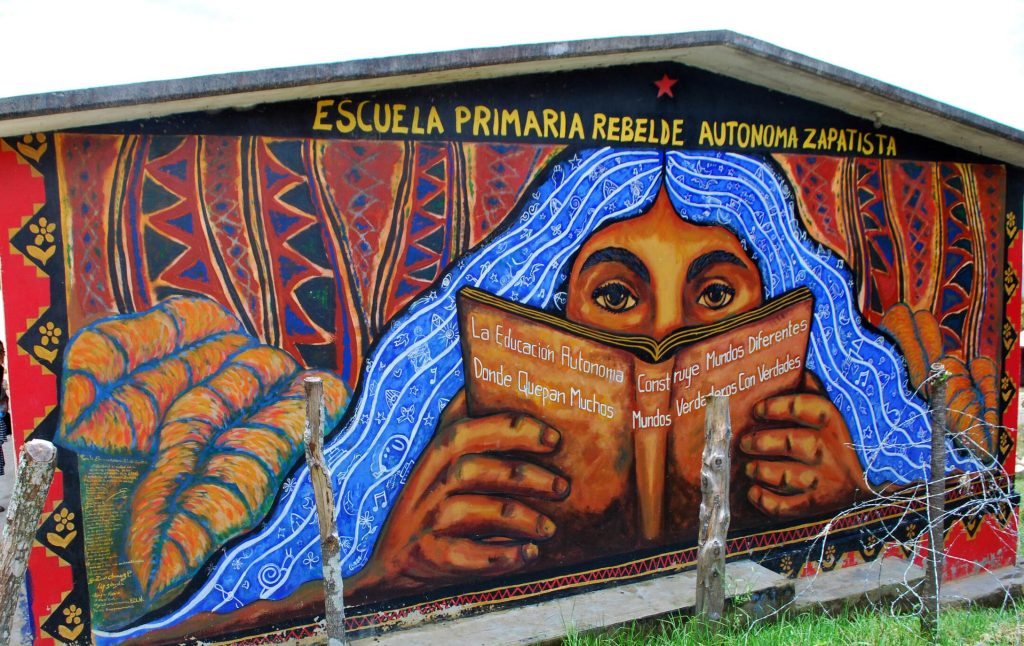
According to this description, collective work exists throughout the whole Zapatista “society,” it is the basic feature of their daily life and it has made it possible to build hundreds of schools and health posts, to maintain production, cooperatives and other collective projects, as well as to build clinics, hospitals and secondary schools, centers for the transformation of primary production and the entire material structure of the hundreds of thousands of Zapatistas who live in more than a thousand communities and are in relation with each other in more than 40 collective spaces of self-government.
But Moisés adds something crucial: “collective work is done not only on Mother Earth (85).” He tells us that tequio/minga/collective work not only is related to production, but incudes all aspects of life, material and non-material. The construction of self-government is based on collective work: from health and education to justice, power and Good Government Councils. How is this organized?
The so-called health “promoters,” who are in charge of health care, bonesetters, mid-wives and medicinal plants, are appointed in the community assembly, not because of their abilities but because it is their turn to serve, to support their community in these tasks. They do not receive remuneration, but the community guarantees their basic needs through collective work: cultivating their milpa (cornfield), supporting them with food and covering their needs. The same happens with the education promoters and with all the tasks necessary for the reproduction of life. That is why Moisés says that “the pay” is the communal care of the cornfield, the bean field, the coffee field, and the pasture. The assembly is also collective work, it is where decisions are taken, and it sustains through collective work those it has appointed. The community supports its representatives in the same way.
One of the great creations of Zapatismo is to have extended collective work to all levels at which they exercise autonomy: local or community, municipal, regional and zone. The Zapatistas who make up municipalities and Good Government Councils also do collective work, to meet, to make decisions and to sustain themselves materially. It is not a question of one level of autonomy sustaining the higher level. In short, collective work substitutes money, and so it goes deeply against capitalism, but there is no political economy that reflects on this reality.
“The point is that everybody does collective work (Moisés 2015, 101).” Collective work is not decided by a central authority, a centralized institution (which would basically reproduce a state system). It is the communities, the regions, the autonomous municipalities and the zones that must agree how the work is going to be implemented and how to organize the distribution, because there are families that have few children and others that have many, so they must discuss how much time they dedicate to work for the family and how much for the collective, and the same goes for all the problems that arise.
As Gladys Tzul points out regarding the indigenous peoples in Guatemala, communal service is not remunerated because “it is the obligatory work that we all have to do for the sustenance of life in common” (Tzul, 2015: 132). This obligatory nature also includes the assemblies on which the indigenous communal government rests, “where the k’ax k’ol (collective work) is the fundamental ground where these systems of communal government are supported and generated and where the full participation of all is at stake” (idem: 133).
At this point, it should be emphasized that the communal assembly is very different to the assembly of urban workers or that of neighbors of a neighborhood or colony. It is obligatory because it is one more collective task. The communal authorities are bearers of the decisions of the assemblies, to the point that “there is no dissociation between communal authority and communal assembly” (Tzul, 2016: 29).
The Zapatista system is decentralized. In each region and village/community they decide what to do with the money from the sale of the collective harvest, whether to pass it to the community bank or invest it in some need of the movement. Community life and values which inspire Zapatismo are based on a broad decentralization that allows the expression of the specificities of each geography and each community1.
For the collective work projects that we are discussing, what has really helped us a lot is working this way, where the month is divided into 10 days of collective work and 20 days of family work. Each person agrees. Someone might say no, 5 days for collective work and 25 for the work of the family. But each place makes their agreement, at the level of the community, or the region, or autonomous municipalities, or zone. These are the four levels at which the collective work projects happen, which is to say there are four levels of assemblies, we could say, four levels at which to come to agreement. (Moisés, 2015: 107).
A decentralized economy, controlled by assemblies and collective works, reproduces another type of society, in which concepts such as property, paid labor and abstract labor, surplus value and accumulation, for example, do not appear. Developing an analysis of a political economy centered on collective work is a challenge for contemporary critical thought and implies decolonizing the categories based on the exploited individual, the wage laborer and replacing them for a type of labor that has no referents in the previous analysis of any current of thought. This is a challenge for all disciplines, not only for economics, since they all take the “individual” or the “citizen” as their point of departure.
The Zapatista bases of support do not hold private ownership of land, nor of any means of production. They only administer the lands recuperated by collective struggle, the same way as they do with all the material creations (schools, clinics, cooperatives, etc.) resulting from collective work. They do not produce exchange values (they only sell a part of the production in the market), but the money collected is reabsorbed as use value, like everything they produce. That is why exchanges with money are minimal, because use value is the norm. Therefore, there is no abstract labor, only concrete labor, nor exploitation or extraction of surplus value. Among the Zapatistas there is no capital, and collective work does not add value to any capital, that is why we are before a non-accumulation of non-capital.
So, the new worlds — Zapatismo is just one of all of them, though the most developed and extensive — , deserve a new type of political economy, which can no longer be referenced in the old one, as it occurred in the socialist countries. The reflections produced by “real socialism” were symmetrical to those of the political economy of bourgeois society: the socialist mode of production was conceptualized, for example, as the “law of primitive socialist accumulation,” and so on with all the categories that were a reflection of the bourgeois economy in the socialist one, to the point that “the initial steps of socialism were compared with the first steps of the capitalist mode of production” (Preobrazhensky 1971, 93).
The organization of the bases of support, the recuperation of the means of production through collective struggle and the extension of collective work to all tasks, is what has made it possible to overcome or decolonize the analytical categories elaborated by Marx in his critique of political economy.
Women at the center of critical thought
Abdullah Öcalan is producing a complete reframing of critical thought inherited from Marx. In his vast reconstruction of history, he offers us a vision of the world focused on the Middle East, the place where Kurdish people are leading their revolution. This question seems to be the key. A history that starts with the peoples who inhabited Mesopotamia cannot but enrich the history of all people, since their particularities add to the universal, as Aimé Cesáire warned us already half a century ago, refusing both to lose himself through “closed segregation in the particular or dilution in the universal.” He opted for “a universal depository of everything particular,” as he ends his letter to Maurice Thorez in 1956 (Cesáire 2006, 84).
Öcalan’s thought is tributary of the women’s movement but also of the fall of Soviet socialism and the decolonizing impulse of the Kurdish movement. Among his most notable contributions is his critique of the economism present in Marxism and in all the tendencies of critical thought. Against those who believe that the birth of capitalism is the “natural” result of economic development, Öcalan drafts a conception that considers it the result of the growth of military and political power, which he considers “the modern link in a chain of tradition that began with the first group of marauders who gathered around the strong man and robbed the social values that had formed around the mother-woman (Öcalan 2017).”
In his view of history, inspired by the historian Fernand Braudel, he considers that violence was and is the driving force of capital accumulation, and that in the colonial wars where original accumulation took place, there were no economic rules. “It [political economy] is the most fraudulent and predatory work of the speculative intelligence, developed to disguise the speculative character of capitalism (Öcalan 2017).” He concludes that “capitalism is power, not economics,” and is based on the concentration of force, armed and unarmed, capable of confiscating the surpluses produced by society.
I am convinced that the central role Öcalan confers political-military power to the birth of capitalism is related to the experience of the Kurdish women’s movement. Something similar can be said on his analysis of the nation-state, which he considers capitalist civilization’s form of power. In tune with the women’s movements of the world, which have changed society without accessing state power, he develops a profound anti-state vocation that leads him to reject, among others, the concept of hegemony as an analytical instrument and as a horizon for changing the world. “Sovereignty, however, means power. Power cannot be achieved without domination, which in turn cannot be achieved without force (Öcalan 2017).”
In fact, in his thinking, there is a connection between the role he grants the woman-mother and the one he assigns the community and, therefore, the centrality of use values. Economy, unlike the capitalist system, serves the basic needs of society and therefore for a very long time was restricted to use value, so closely linked to the communal order (Öcalan 2017, 460).” Similarly, he contrasts production for profit and accumulation of power, with the “gift economy.”
He argues that the destruction of the “previous society,” the one before the “civilized” one, a society that he considers synonymous to the woman-mother, is a consequence of the conversion of the male into a hunter, whose physical strength represented “a threat to the matriarchal order” and leads to a “state” organization when agricultural surpluses allow it (Öcalan 2016, 225). The previous society, anchored in the centrality of the woman-mother, was destroyed by “the onset of commodification and trade, which penetrated through the veins of the colonies, and accelerated the dissolution of society by the spread of commodities, the heat of exchange and the generalization of property” (idem).
In my opinion, the importance that the Kurdish leader gives to use values and community in history, dialogues with what has been happening with the peoples in movement, particularly in the Zapatista territories in Chiapas and the Nasa in the Colombian Cauca. We could mention the centrality of barter in the Minga hacia Adentro thanks to which the Regional Indigenous Council of Cauca (CRIC) resists during the pandemic.
The Kokonuko people, who are part of the CRIC, held more than sixty fairs to exchange agricultural products through bartering, in various indigenous reserves (resguardos). Hundreds of people participate in each fair, mostly young people, who don’t use money and defend a “clean economy in which barter is a policy against neoliberalism and against any currency (Zibechi 2020).” The Nasa people consider barter, based on use values, a political alternative to capitalism. They exchange products from different climates, from cold and warm lands, but they do not do it on equivalences (1 kilo for 1 kilo), but on the basis of the needs of each family. They call this system “our own economy,” which is the name given to the non-capitalist economic system, anchored in the use values that operate in the territories of the native peoples of Cauca.
It is the way to recuperate the place of the woman-mother — returning to Öcalan’s concept — although it is a role that goes beyond gender and can be played by a man or a woman. For Öcalan, capitalism is not the consequence of an almost natural “development” of the economy, triggered by technological evolution, as Marx argued (“The handmill gives you society with the feudal lord; the steam-mill, society with the industrial capitalists,” he wrote in The Poverty of Philosophy), but of a military, political and cultural tradition to “usurp social values (Öcalan 2017, 83).”
Instead of technology, he places at the center the “forty thieves.” With that movement, everything changes, history and current reality take on other forms, emerging from the opacity in which political economy had cloistered them. But these thieves not only steal material things to enrich themselves, they also usurp what he calls “social values.” What are these? The place of women: “We could also describe the rise of capitalism as the the modern link of the tradition of usurpation of values corresponding to the woman-mother by the “strong man” and the group of bandits and thieves that accompany him” (idem).
Öcalan says that the lords and masters, the modern bourgeoisie enriched by the colonial wars of conquest that formulated a political economy which, disguised as science, seeked to hide the essence of capitalism, came from that group of thieves. These are not economic forces but dominators who impose, from outside and against the economy, their power-concentrating logic.
It is at this point where I find that the emancipatory practice of the Zapatista bases of support, the indigenous peoples organized around the CRIC and the theoretical and concrete Kurdish experience, are intertwined. It is not about a “return to the community” driven by some kind of nostalgia, much less by questions of ideological nature. The centrality that communities, use values and women acquire stems from the need to overcome and resist capitalism, understood as a war of dispossession against humanity.
The peoples in movement are not seeking a lost ideal society, it is not nostalgia for a lost world or one that they desire, but something more transcendent: to overcome the current state of things, it is imperative to recuperate the type of world, society, or “values” — whichever denomination one might prefer — that the system has cornered and intends to destroy. In this effort to sustain life, they find community, use values and the central role of the woman-mother as realities that refer to another logic, another ethic and way of life.
Towards a “civilization of freedom?”
Braudel is skeptical about rapid and irreversible changes: “I don’t believe, in general, in rapid social mutations, like coups de théâtre. Even revolutions are not total ruptures” (Braudel, 1984: 42). The changes at the top, such as the advent of new broods of governors, he argues, often reinforce the established order. It establishes a dialectic between short time and long time, between disruptive events and continuities, given that cultures mutate slowly. In our work, it would be like the dialogue between uprisings and insurrections and the construction of a new political culture, processes that converge or diverge, according to a priori unpredictable events.
He uses the concepts of civilization and culture interchangeably, he considers them of an “endless duration that exceeds, by far, the longevity, however impressive, of the world-economies” (Braudel, 1984: 45). And takes distance from a vulgar Marxism that places culture in the superstructure, subordinated to the relations of production. And he continues, always sharp: “It (culture) is the oldest character in the history of humanity: economies are replaced, economic institutions crack down and societies succeed one another, but civilization continues its path”; and finishes with a wise assertion: “Civilization is the old man, the patriarch, of the history of the world” (idem).
If there is anything on earth capable of limiting the expansionist voracity of the economy (not only the capitalist one) — affirms the historian — it is culture, capable of achieving what society (and politics) can’t. Because it conjugates the three variables in a lax and at the same time concrete, articulation.
The two peoples in movement mentioned above emerge from processes that began decades ago, shaping new political cultures that resist all efforts to constrain and tame them. After a long and intense century, feminisms have instilled themselves in our societies, producing long-lasting changes in the situation of patriarchy; meanwhile, indigenous peoples appear as decolonizing subjects, capable of re-producing comprehensive social relations (which professional politicians have theorized as “good living”), which propose an alternative to the crisis of capitalist civilization.
Zapatism is a creation of the indigenous peoples, surely the most advanced, in a vast constellation of autonomous and self-governed creations anchored in thousands of communities. It did not invent collective work, but it had the virtue of understanding its emancipatory potential and multiplying it in all practices, in the most diverse spaces, to the point that it models their world and configures an unmistakable culture or way of doing politics, from the smallest practice to the most extensive. When the bases of support (and schoolchildren) are asked a question, they first consult among themselves and only after they have found the answer, someone expresses it.
The PKK did not invent feminism. It was women in exile and in the mountains who learned it, out of necessity, not ideology. They adapted it to the specific conditions of the history and traditions of the Middle East, and then multiplied it till each and every action and reflection, from the cantons and neighborhoods of this vast movement was soaked in Jineolojî. They have delved so deeply in their understanding of the oppression of women that they affirm that the state was created on the domestication of women and consider that “killing the dominant male” is the core of the revolutionary movement.
We may be at the dawn of something new, so much so that we do not yet have the words to name it. If the concept of “social movements” seems inadequate, that of “peoples in movement” may be insufficient since they are not only moving (in the double sense of mobilizing and altering an inherited material and symbolic place). The power of both collective subjects (rebellious women and peoples in movement) has placed them as the main force of the new world and the threat the elites most fear, since they show the way to the decolonization/depatriarchalization of social relations, processes so closely knotted that it is not possible to work consistently one of them, without intervening in the other (Galindo 2013).
When the tired Western civilization collapses, it is possible that a new one is emerging before our eyes, perhaps a “civilization of freedom” (which Öcalan calls “democratic civilization”) that sinks its roots in the communitarian history of humanity; torn apart by colonialism and capitalism (functional allies of patriarchy) and now re-emerges with all its restorative power of life in common. With the concept “democratic civilization,” Öcalan seeks to “conceptualize both the social forms prior to the state and civilization and those that, after the emergence of the latter, remained outside the state” (Öcalan 2017, 454). The above implies that -contrary to what sociology and Marxism consider-society and state are contradictory and not complementary.
At this point it is necessary to re-conceptualize what we understand by colonialism, based on the history and reality of Latin America. “Colonialism is the superimposition of societies under relations of domination and exploitation” (Tapia, 2019: 147). Based on the historical experience of Upper Peru (present-day Bolivia) and the Andean region, Tapia establishes three characteristics of colonialism, which allow him to affirm not only that it has not ended, but that it is expanding (far from those who analyze the current reality as post-colonial or insist on the concept of de-coloniality).
Luis Tapia’s analysis of internal colonialism, focused on Bolivia -but shining light on the Latin American reality- overflows and surpasses the works known so far, since it has the enormous, but not only virtue, of pulling back the veil of progressive policies, which are usually camouflaged by the speeches of their leaders and by academics graduated in the art of confusion.
The first characteristic of internal colonialism comes from the transformation of agrarian peoples into semi-extractivist ones, which he considers “the most enduring feature of colonialism” (Tapia, 2019: 148). Through extractivism, the dominated society works for the dominant one as it used to do by paying tribute, thus continuing a five-century-old policy.
The second one is the “disorganization of self-government”, which was one of the main characteristics of native peoples before the conquest. The colony did not destroy completely the original self-government, but managed to attach, in a subordinate way, some community authority structures in order to ensure the payment of tribute to the dominant imperial power. What happened, in fact, is that production and community organization at the micro scale, ayllu, community or marka, was maintained, but unity at a higher, or macro, scale was broken through the political decapitation or the reduction of the political dimension of the colonised societies:
This disorganization of the macro political level led to the fact that the productive and social structures of the conquered societies remained stronger at micro, local and regional level and have faced a condition of partial impossibility to develop their cultures, because of this loss of the political dimension of self-government and macro articulation, which is carried out by the structures of imperial power (Tapia, 2019: 149).
However, the survival of the micro community level, has been key in the political process that the peoples have been living these last two centuries (since the rebellions of Tupac Katari and Tupac Amaru) and, more recently, since the dissemination of the Tiwanaku Manifesto in 1973, giving birth to the katarista current in Bolivia.
The third aspect analyzed by Tapia is the establishment of a hierarchy between societies, since “the colonial relation is a relation between societies”, which involves denying the subjected society its condition of society and its members the condition of human beings, through racism. As part of this colonial domination, the authority structures of the conquered societies take a place of subordination, since these same authorities seek the recognition of the dominator in order to maintain their own privileges (material and symbolic) over their people, and act as mediators between the two (republic of Indians/republic of Spaniards) ultimately defending the colonial order.
For this reason, the liberation or de-colonization of native peoples must go through a double process: recuperating the past and, at the same time, becoming aware of the internalization of domination in the figure of caciques [chiefs] and other authorities functional to colonization. In this aspect, I find an enormous similarity between the emancipatory processes of feminist women and native peoples: patriarchal and colonial domination have been internalized for so long, and with such intensity, that they have become naturalized and liberation mainly implies understanding what there is of the dominator in the dominated people, what must be disarmed, and dismantled, to “disarticulate each and every one of the layers of oppressions that hold us down” (Galindo, 2013: 174).
In line with the main thinkers and leaders of indigenous movements, Tapia points out that overcoming the colonial relationship implies the rearticulation or recuperation of the political dimension suppressed by the conqueror, re-establishing updated diverse modes of autonomy and self-government. Zapatism is doing this through good governance councils, and Kurds in their “autonomous communities” of the Afrin, Jazira and Kobane cantons, which have endowed themselves with a constitutional charter (Constitution of Rojava, 2014). But it is also the path undertaken by a diversity of peoples throughout the Latin American region, from the inhabitants of Cherán (Mexico) to the Wampis of northern Peru, very diverse processes involving lowland and highland peoples, non-indigenous peasant communities and urban migrants.
However, decolonization cannot be achieved by simply reconstituting the old forms of self-government with their respective authorities. The intensification of extractivism and capitalism in the territories inhabited by the peoples, as well as the anti-patriarchal struggle of women, make this impossible, because it would be an anachronism that would lead to the construction of new modes of oppression. In the past, the resistance and reconstitution of the peoples was truncated by repression and genocides, but more recently subtle modes of co-optation were established, such as the “plurinational states”, in which the codification of plurinationality in state format meant maintaining and reinforcing the main features of the hegemonic colonial culture (Tapia, 2008).
One of the most hopeful features of the current period is that the peoples in movement (and women in rebellion) are not repeating the precepts of the struggles of the past, which consisted basically in the seizure of state power in order to carry out structural transformations later. The two cases analyzed, as well as many others that we have witnessed in the last two decades, show different paths from those already known (Zibechi 2018). What these other societies are breeding is quite different from what the socialist revolutions of the twentieth century produced.
“One of the main causes of servitude — reflects Luis Tapia — is custom, that is, the experience of being born and living in contexts always organized by structures of inequality and discrimination, governed by social and political hierarchies” (Tapia 2019, 100). What kind of society is being shaped in territories where the relations that predominate between men and women are more or less egalitarian, or amalgamated around collective work? What will people be like after once they have practiced self-government and self-management for a long period of time, not only at local/community level, but in broad regions and territories free from bad governments? Discerning the political culture of individuals and collectives that have grown up, for more than three decades, in spaces where they consciously work against inequality and condemn all kinds of discrimination, that is, where colonial and patriarchal relations are questioned, is a challenge that critical thinking is still far from having addressed.
What politics and what economy are born from collective work in Zapatista territories? How shall we name them? What politics and what powers are born from the guerrilla brigades integrated only by women? Taking only the question of armed struggle, can we apply the concepts of strategy and tactics to the Kurdish women’s army? These are questions for which we still do not have answers, and for which we do not want to have them either: it is those who rebel, the ones who shall name them, since those who name and from where they do it, is part of the decolonizing process.
It would be a grave error, of colonial/ patriarchal nature, to think that the new modes will be presented in the same format as the old political culture that is in crisis. We should not believe that the “civilization of freedom” aspires to defeat/overthrow the capitalist/state civilization in order to impose its hegemony on society as a whole. The conflict between these two societies/cultures/civilizations is not and cannot be symmetrical to the class struggle, since it responds to very different logics. The triumph of the working class in the communist revolution is, according to Marx, the end of wage labor and therefore the denial of the proletariat.
In various works he defended the thesis that the working class needs to become the ruling class in order to suppress the old relations of production. In the Manifesto of the Communist Party, he emphasizes that the aim is to suppress also “the conditions for the existence of class antagonisms and of classes generally, and will thereby have abolished its own supremacy as a class.” In other works he was even clearer:
“In all revolutions up till now the mode of activity always remained unscathed and it was only a question of a different distribution of this activity, a new distribution of labour to other persons, whilst the communist revolution is directed against the preceding mode of activity, does away with labour, and abolishes the rule of all classes with the classes themselves” (Marx, 1974: 81).
By contrast, the peoples are rebelling to continue being what they are, to maintain their communities as such by transforming themselves in the process of moving. Peoples struggle to recuperate and maintain their traditional ways and means of life, updating them because, as I said above, it is not a matter of simply restoring what existed. The last thing they want is “to put an end to their own previous condition of existence” (Marx 1974, 90). What I call updating their traditions goes through several processes: on the one hand, sifting traditions to maintain only those that do not oppress others, as is the case with patriarchy; on the other, identifying customs or ways that have emancipatory potential (such as the minga/tequio) in order to generalize them, once freed from their archaic ties.
There is no possible symmetry with class struggle, and this is something that the different lefts still cannot understand, just as they cannot accept the feminist logics of collective care as a fundamental way of doing politics. This difficulty was very visible when the National Indigenous Congress of Mexico and the EZLN launched Marichuy’s candidacy. Many people who were close to Zapatism thought that it was just another electoral campaign, similar to those carried out by political parties, without understanding that there were other objectives, other forms and, therefore, other ways of walking.
To limit the resistance of the peoples to the schemes of class struggle is a colonialist theoretical-political attitude. It ends up imposing on them, from the outside and from above, objectives and ways that they have not chosen. The peoples have other ways of doing politics and of organizing themselves, other times and ways, because their objective is to continue being peoples, for which they need to struggle to get rid of capitalism, colonialism and patriarchy. The organizations that considered themselves vanguard, needed to create a social base of “masses” to lead them, providing themselves with a leadership that, in the words of a Sandinista commander, “directed and determined the whole movement.” Thus, the FSLN “was faced with the monumental task of building, from its own apparatus, the organizational and revolutionary movement of the masses” (Wheelock 1986, 64). The apparatus commanded and the people obeyed.
To the extent that extractivism, one of the main and most enduring features of colonialism, is more and more profound, we can say that we are facing a neo-colonial regime that reproduces the history of a society superimposed on another: in this case, it is a particular alliance between large multinationals and middle-class sectors of the North and South, who oppress the societies at the bottom, in all regions of the world. This reality, fruit of neo-liberalism and the 1968 revolutions, should lead us to reflect that the anti-colonial and anti-patriarchal strategies of the peoples are necessary inspirations for all oppressed societies.
The movement of the peoples cannot consist in taking state power to impose their hegemony over others, because it would be as much as consummating their own self-destruction, by becoming what they do not want to be, reproducing the dynamics of the master and the slave. They are doing it a different way; the same way the native peoples of Latin America have been resisting the five centuries of colonialism: keeping the enemy at a distance, in order to sustain and reproduce the “radical otherness” of their own world (Zibechi 2019).
References
Abdel-Malek, Anouar. 1975. Una dialética social, Petrópolis, Paz e Terra. [English version: Social Dialectics: Civilizations and Social Theory. 1981. Translated by Mike Gonzalez. 1981]. New York: State University of New York Press.
AAVV. 2015. La revolución ignorada. Liberación de la mujer, democracia directa y pluralismo radical en Oriente Medio, Barcelona: Descontrol.
Braudel, Fernand. 1984. Civilización material, economía y capitalismo. Tomo III. El tiempo del mundo, Madrid, Alianza. [English version: Civilization and Capitalism: Perspective of the World. Volume III. 1992. Translated by Sian Reynolds], California: UC Press.
Césaire, Aimé. 2006. Discurso sobre el colonialismo, Madrid, Akal. [Discourse on Colonialism. 2000. Translated by Joan Pinkham]. New York: NYU Press
Constitución de Rojava (2014) “Carta de las comunidades autónomas de Rojava,” 18 de octubre, en http://www.resumenlatinoamericano.org/2014/10/18/especial-texto-completo-de-la-constitucion-de-las-comunidades-autonomas-kurdas-de-rojava/ (consulta 26/12/2019). Galindo, María. 2013. A despatriarcar, Buenos Aires: Lavaca.
Marx, Karl. 1977. Introducción general a la crítica de la economía política, México, Pasado y Presente. (Einleitung)
Marx, Karl, Federico Engels. 1974. La ideología alemana. Montevideo: Ediciones Pueblos Unidos. [English version: The German Ideology]
Moisés, Subcomandante insurgente. 2015. “Economía Política I y II. Una mirada desde las comunidades zapatistas” en El Pensamiento Crítico Frente a la Hidra Capitalista I. 77-108. México: Comisión Sexta del EZLN. [English version available at: http://enlacezapatista.ezln.org.mx/2015/05/20/political-economy-from-the-zapatista-communities-ii/ and: http://enlacezapatista.ezln.org.mx/2015/05/24/political-economy-from-the-perspective-of-the-communities-i-words-of-subcomandante-insurgente-moises-may-4-2015/%5D
Öcalan, Abdullah. 2017. La Civilización Capitalista. La era de los dioses sin máscaras y los reyes desnudos. Caracas: Comité de Solidaridad Kurdistán-Venezuela. [English version: The Age of Unmasked Gods and Naked Kings. Manifesto for a Democratic Civilization, Volume II. 2017. Norway: New Encompass, International Initiative.]
Öcalan, Abdullah. 2016. Orígenes de la civilización. La era de los dioses enmascarados y los reyes cubiertos, Buenos Aires: Sudestada. [English version: Manifesto for a Democratic Civilization Volume I: Civilization. The Age of Masked Gods and Disguised Kings. 2015. Norway: New Encompass, International Initiative.]
Preobrazhensky, Evgeni. 1971. La nueva economía, México: ERA.
Tapia, Luis. 2019. Dialéctica del colonialismo interno. Santiago: Quimantú.
Tapia, Luis. 2008. Una reflexión sobre la idea de un estado plurinacional. La Paz: Oxfam.
Tzul Tzul, Gladys. 2016. “La producción comunal de la autoridad indígena. Breve esbozo para Guatemala,” El Apantle, Nº 2, octubre. Puebla: Sociedad Comunitaria de Estudios Estratégicos: 17-36.
Tzul Tzul, Gladys. 2015. “Sistemas de gobierno comunal indígena: la organización de la reproducción de la vida,”El Apantle, Nº 1, octubre. Puebla: Sociedad Comunitaria de Estudios Estratégicos: 125-140.
Wheelock, Jaime. 1986. Vanguardia y revolución en las sociedades periféricas, México: Siglo XXI.
Zibechi, Raúl. 2019. “La radical otredad,” prólogo a Albarenga, Pablo Retomada. Montevideo: Alter: 6-12.
Zibechi, Raúl. 2018. Movimientos sociales en América Latina. El “mundo otro” en movimiento, México, Bajo Tierra.
Zibechi, Raúl. 2014. Descolonizar el pensamiento crítico y las prácticas emancipatorias. Bogotá: Desdeabajo.
- The EZLN is composed of at least five peoples, as well as mestizos, who live in mountain, jungle and intermediate regions. ↩︎